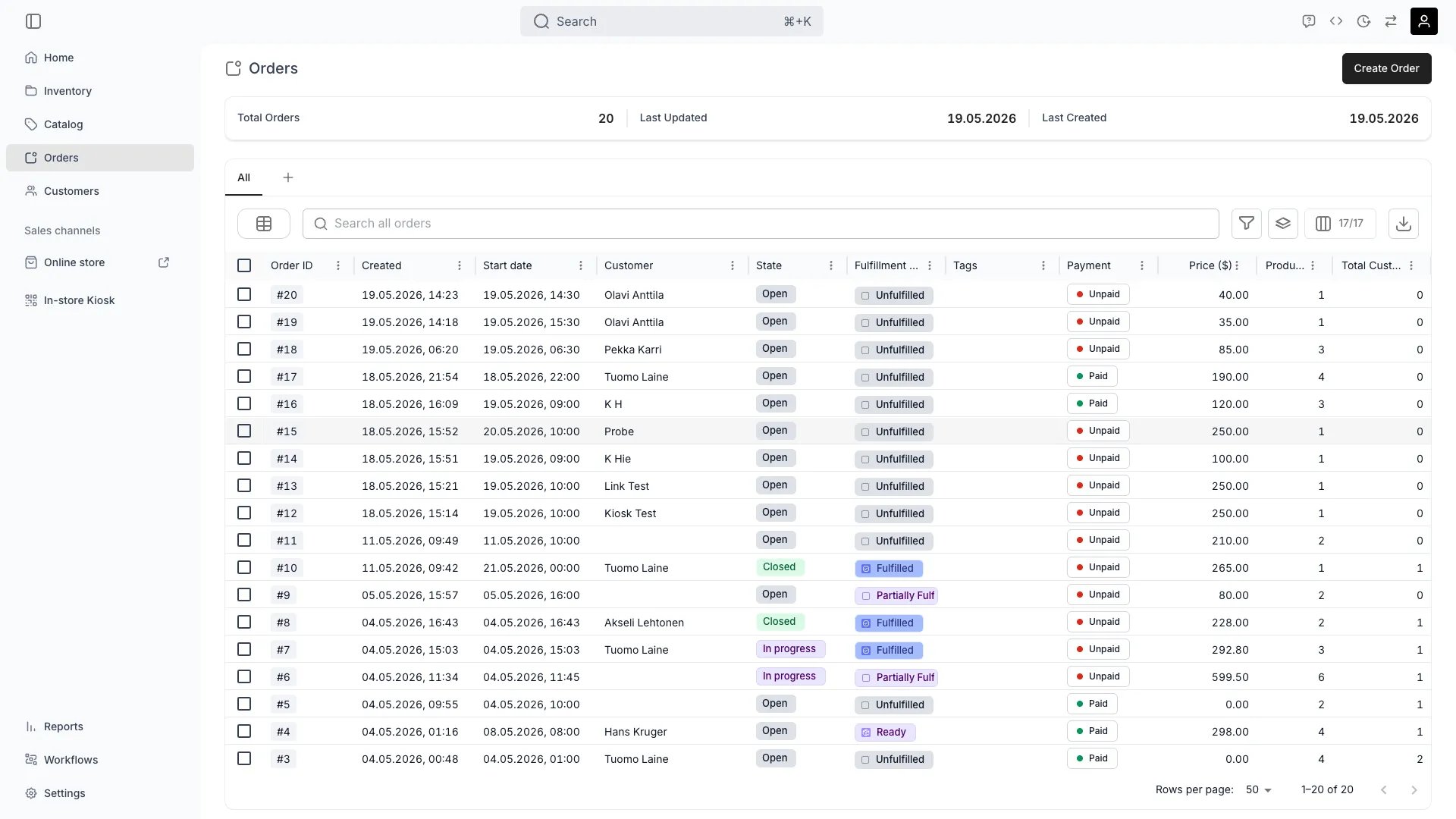
Type in the Search all orders box to find an order. The search matches:
The order reference. A partial reference such as 63 matches too.
A customer name. Any customer on the order matches, the main contact included.
A stock item code or name. Type the registration number from a key tag to find the order the unit went out on. The search reads the code and name recorded on the order, so a unit you have since renamed, recoded or deleted still finds its orders.
The search does not match company names or order status. Use the column filters to narrow by status.Read more: Mark items returned
Filter by purchase type
The Purchase Types column shows which types of line items each order contains — Booking, Subscription, Sale, or Buyback — displayed as chips. Filter the column to find all orders that include a specific purchase type.Read more: Order Types
Calendar view
The Layout control to the left of the search box opens a menu of layouts — the grid, and a calendar of pickups and returns. It is disabled while the table is grouped, so clear the grouping to switch layouts.The calendar plots the orders currently loaded in the table, which means your filters and the page you are on decide what appears on it. It opens on Grid Week; Grid Month, Grid Day, List Day, List Week and List Month are the other views, and Today with the arrows beside it moves the range.Each event groups the pickups or returns falling in the same slot, and its title counts the orders and stock items behind it. Pickups carry a purple up arrow, returns a blue down arrow.Clicking an event opens a popup that lists one row per order and time:
Order reference · customer name on the top line. An order with no customer shows the reference alone.
Pickup or Return, the time, and the number of stock items on the second line.
A chevron marks the row as a link. Click it, or press Enter or Space, to open that order.
Scrolling the calendar or clicking outside the popup closes it.
Create orders directly in the admin for in-person sales, phone orders, or special cases. The order is saved the moment you press Create Order, with no draft form to submit.Read more: Create an order
Manage Fulfillment
Track and manage order fulfillment, including item preparation, pickup, delivery, and returns.Read more: Start an order · Complete an order
Tick the rows of the orders you want, open Actions in the selection bar, and select Print documents. Pick a document template, check the preview, and select Print to print every selected order in one job, one page per order.Printing works on the archived view too. The picker lists the active document templates available for orders, which you set up under Settings → Documents. Press 1 to 9 to pick one of the first nine templates.
Orders > Overview
Orders > Overview > Print documents
TWICE Commerce loads each order before it prints, so the dialog shows “Preparing 3 of 12 documents…” while it works. Print stays disabled until every order has loaded.Select up to 50 orders at a time. A larger selection opens a dialog titled “Too many selected to print” that reads “60 items are selected, and up to 50 can be printed at once. Narrow the selection and try again.” Filter the table down and select again.Selecting every row that matches a filter prints only when the rows are loaded in the table. If the match is larger than the loaded rows, Print documents is disabled, and hovering it explains: “Printing covers the rows loaded in the table. Narrow the filters so the selection fits, then print.”If some orders fail to load, the dialog reads “Couldn’t load 2 of the selected documents.” Select Try again to reload them. When the message reads “Your role cannot load the data these documents render from. Ask an admin for access to notification settings.”, ask an admin to give your role view access to Settings → Emails.
Archive Orders
Archiving takes an order out of the table without deleting it, and is separate from closing.Archiving an open order closes it first, so the confirmation asks you to acknowledge that:
Checkout links stop working.
Scheduled payment collections stop.
Subscriptions are cancelled.
The order becomes read-only.
A selection mixing open and closed orders lets you archive only the closed ones instead.Archiving also revokes the order’s still-active checkout links: they move to Revoked on the Payment tab and tell the customer the link has been cancelled. A link that had already expired or been used keeps that state. Unarchiving returns an order to closed, but does not restore its links — issue a new one to collect again.Nothing is archived automatically. Review and restore archived orders in Settings → Archived assets.Read more: Archiving and Deletion · Archive an order · Unarchive an order
The Orders table includes the following columns. All columns support standard table features such as column visibility, pinning, and reordering.
Column
Filter
Sort
Description
Reference
Text
Yes
The order reference, formatted by your order numbering settings. Filtering matches the reference as text; sorting groups by prefix and then orders numerically, so A9 sorts before A10
Created
Date
Yes
When the order was created
Start date
Date
Yes
Start of the booked period
End date
Date
Yes
End of the booked period
Main contact
Text
Yes
The order’s billing contact. Named Customer until October 2026; the rename is a label only, so a saved view that carried the column keeps it
Customers
Select
Yes
Every customer on the order, where Main contact names one
State
Select
Yes
The order’s state within its stage
Item states
Select
No
The fulfillment states present across the order’s items
Stage
Select
Yes
The order’s status: Open, In progress or Completed. The same three on every account. Your own state names are in State
Fulfillment state
Select
Yes
Fulfillment state: Unfulfilled, Partially fulfilled, Fulfilled, Partially returned, or Returned
Purchase types
Select
No
Purchase types on the order: Booking, Sale, Subscription, or Buyback
Tags
Select
Yes
Tags assigned to the order. The filter offers two rules, Has and Has not, and reads the order’s whole tag set when the tag picker is left empty. See Tables
Payment
Select
Yes
Payment status: Paid, Partially paid, or Unpaid. Unpaid excludes partially paid orders, so add Partially paid to a saved view that filtered on Unpaid to catch them
Deposit
Select
Yes
Deposit status: Not reserved, Reserved, Partially captured, Captured, or Cancelled. Sorting follows that order, not the alphabet. The cell is blank when the order has no deposit
Price
Numeric
Yes
Order total in the selected currency
Listings
Select
No
Distinct listing names from the order’s catalog-backed line items, displayed as a comma-separated list. Filter by selecting one or more listings from the dropdown.
Line items
Numeric
Yes
Total number of line items on the order
Total Customers
Numeric
Yes
Number of customers on the order
Sales Channel
Select
Yes
Channel the order was placed through. The filter offers Admin and API; online orders cannot be filtered by channel.
Location
Select
No
Service location associated with the order
Has conflicts
Select
Yes
Whether the order has stock item conflicts
The Date filter on Created, Start date, and End date offers the operators described in Tables, including the relative-day operators that need no date picker.The table adds one column for every order attribute, global or not. The column header is the attribute name. An order that never captured the attribute shows an empty cell.
Attribute format
Filter
Sort
Text, Number, Yes / No, Date, Date & Time, Select
Yes
Yes
Multi-select
Yes, matches orders holding any of the picked options
This view is gated by orders:order, in the four operations — , , and .All four system roles — Owner, Admin, Manager and Member — hold every operation on this.For what each operation means and the full role matrix, see Users & Roles.
Working the conflicts banner on this table down to zero.
Planning the day
Today’s pickups and returns, overdue orders, and the day on a calendar.
Cancelling an order
Cancel an order, archive it, or bring an archived one back.
Cancel an order
Marking every item excluded, refunding what the customer paid, and closing the order.
Was this page helpful?
{"docsConfig":{"theme":"aspen","$schema":"https://mintlify.com/docs.json","name":"TWICE Commerce","colors":{"primary":"#212121","light":"#F4F4F4","dark":"#212121"},"logo":{"light":"https://mintcdn.com/twicecommerce/KD5MbyezoVxgw-eX/logo/twice-logo-solid.svg?fit=max\u0026auto=format\u0026n=KD5MbyezoVxgw-eX\u0026q=85\u0026s=a1a71755cbd917f23fac5655a627e893","dark":"https://mintcdn.com/twicecommerce/KD5MbyezoVxgw-eX/logo/twice-logo-solid_white.svg?fit=max\u0026auto=format\u0026n=KD5MbyezoVxgw-eX\u0026q=85\u0026s=19eb2023f5a2e29f22337e86347abdb5","href":"https://www.twicecommerce.com/"},"favicon":"https://mintcdn.com/twicecommerce/KD5MbyezoVxgw-eX/favicon.svg?fit=max\u0026auto=format\u0026n=KD5MbyezoVxgw-eX\u0026q=85\u0026s=8572ad950e73aaf44bbd9960aa4a8068","api":{"openapi":{"source":"https://server.twicecommerce.com/api/admin/openapi-mintlify.json"},"params":{"expanded":"all"},"playground":{"display":"interactive"}},"appearance":{"default":"light","strict":true},"navbar":{"links":[{"href":"https://www.twicecommerce.com/","label":"Homepage"},{"href":"https://admin.twicecommerce.com/login","label":"Log in"}],"primary":{"type":"button","label":"Book a demo","href":"https://www.twicecommerce.com/demo"}},"footer":{"socials":{"linkedin":"https://linkedin.com/company/twicecommerce"}},"seo":{"metatags":{"charset":"UTF-8","viewport":"width=device-width, initial-scale=1.0","indexing":"navigable"}},"fonts":{"body":{"family":"Inter"}},"styling":{"eyebrows":"breadcrumbs","latex":true},"errors":{"404":{"redirect":false,"title":"Page not found","description":"**Looking for TWICE 1.0 docs?** They moved to [support.twicecommerce.com](https://support.twicecommerce.com) — 1.0 guides that used to live under `/docs` are all there now.\n\nOn **TWICE Commerce 2.0** you're in the right place: use the search above, or [start from the beginning](/index)."}},"contextual":{"options":["copy","view","chatgpt","claude","perplexity","mcp","cursor","vscode"],"display":"header"},"navigation":{"languages":[{"language":"en","href":""},{"language":"fi","href":"fi"},{"language":"cs","href":""}]}},"deployment":{"deploymentMetadataValue":{"subdomain":"twicecommerce","hasAudioNarration":false,"actualSubdomain":"twicecommerce","customDomains":["www.twicecommerce.com"],"gitSource":{"type":"github","owner":"rentle","repo":"twice-docs","deployBranch":"main","contentDirectory":"","isPrivate":true,"mountPath":"","label":""},"feedback":{"thumbs":true,"edits":false},"entitlements":{"AI_CHAT":{"status":"DISABLED"}},"buildId":"6af515552bca87eef5a7a113","clientVersion":"0.0.4111","searchFilterCounts":[{"language":"default","tag":"Admin API","count":396},{"language":"default","tag":"API","count":198},{"language":"fi","tag":"Dokumentaatio","count":186},{"language":"en","tag":"Docs","count":180},{"language":"cs","tag":"Dokumentace","count":180},{"language":"en","tag":"Guides","count":138},{"language":"cs","tag":"Návody","count":138},{"language":"fi","tag":"Oppaat","count":138},{"language":"en","tag":"Navigating in TWICE","count":129},{"language":"cs","tag":"Orientace v TWICE","count":129},{"language":"fi","tag":"Liikkuminen TWICEssä","count":129},{"language":"en","tag":"Working in TWICE","count":108},{"language":"cs","tag":"Práce v TWICE","count":108},{"language":"fi","tag":"Työskentely TWICEssä","count":108},{"language":"en","tag":"Inventory","count":56},{"language":"en","tag":"Orders","count":56},{"language":"cs","tag":"Inventář","count":56},{"language":"cs","tag":"Objednávky","count":56},{"language":"fi","tag":"Inventaario","count":56},{"language":"fi","tag":"Tilaukset","count":56},{"language":"en","tag":"Settings","count":54},{"language":"cs","tag":"Nastavení","count":54},{"language":"fi","tag":"Järjestelmän ymmärtäminen","count":54},{"language":"fi","tag":"Asetukset","count":54},{"language":"en","tag":"Catalog","count":53},{"language":"cs","tag":"Katalog","count":53},{"language":"fi","tag":"Katalogi","count":53},{"language":"en","tag":"Understand the system","count":51},{"language":"cs","tag":"Jak systém funguje","count":51},{"language":"cs","tag":"Prodejní kanály","count":45},{"language":"fi","tag":"Myyntikanavat","count":45},{"language":"en","tag":"Sales Channels","count":39},{"language":"default","tag":"orders","count":25},{"language":"default","tag":"catalog","count":24},{"language":"default","tag":"articles","count":23},{"language":"default","tag":"pricingTables","count":22},{"language":"default","tag":"files","count":13},{"language":"default","tag":"skus","count":12},{"language":"default","tag":"customers","count":11},{"language":"default","tag":"collections","count":9}]},"assistantConfig":{"enableAskAiButton":false,"enableStarterQuestions":false,"enableAskAiSearchBar":true},"basePath":"/docs","hasChatPermissions":false,"hasWebMcpPermissions":false,"toggles":[{"name":"kill-isr","enabled":true,"variant":{"name":"disabled","enabled":false,"feature_enabled":true},"impressionData":false},{"name":"custom-rbac-roles","enabled":true,"variant":{"name":"disabled","enabled":false,"feature_enabled":true},"impressionData":false},{"name":"agent-mintlify-slack","enabled":true,"variant":{"name":"disabled","enabled":false,"feature_enabled":true},"impressionData":false},{"name":"agent-integrations-settings","enabled":true,"variant":{"name":"disabled","enabled":false,"feature_enabled":true},"impressionData":false},{"name":"rbac-expansion","enabled":true,"variant":{"name":"disabled","enabled":false,"feature_enabled":true},"impressionData":false},{"name":"automations-pr-grouping","enabled":true,"variant":{"name":"disabled","enabled":false,"feature_enabled":true},"impressionData":false},{"name":"custom-prefix","enabled":true,"variant":{"name":"disabled","enabled":false,"feature_enabled":true},"impressionData":false},{"name":"analytics-v7","enabled":true,"variant":{"name":"disabled","enabled":false,"feature_enabled":true},"impressionData":false},{"name":"user-flows-analytics","enabled":true,"variant":{"name":"disabled","enabled":false,"feature_enabled":true},"impressionData":false},{"name":"no-publish-flow","enabled":true,"variant":{"name":"disabled","enabled":false,"feature_enabled":true},"impressionData":false},{"name":"workos-onboarding","enabled":true,"variant":{"name":"disabled","enabled":false,"feature_enabled":true},"impressionData":false},{"name":"llms-txt-v2","enabled":true,"variant":{"name":"disabled","enabled":false,"feature_enabled":true},"impressionData":false},{"name":"snapshot-serving-live","enabled":true,"variant":{"name":"disabled","enabled":false,"feature_enabled":true},"impressionData":false},{"name":"stripTemperatureMiddleware","enabled":true,"variant":{"name":"disabled","enabled":false,"feature_enabled":true},"impressionData":false},{"name":"support-platform-pylon-zendesk","enabled":true,"variant":{"name":"disabled","enabled":false,"feature_enabled":true},"impressionData":false},{"name":"snapshot-serving","enabled":true,"variant":{"name":"disabled","enabled":false,"feature_enabled":true},"impressionData":false},{"name":"instant-rollback","enabled":true,"variant":{"name":"disabled","enabled":false,"feature_enabled":true},"impressionData":false},{"name":"granular-notifications-server","enabled":true,"variant":{"name":"disabled","enabled":false,"feature_enabled":true},"impressionData":false},{"name":"granular-notifications","enabled":true,"variant":{"name":"disabled","enabled":false,"feature_enabled":true},"impressionData":false},{"name":"automations-fable","enabled":true,"variant":{"name":"disabled","enabled":false,"feature_enabled":true},"impressionData":false},{"name":"fixed-ai-action-pricing","enabled":true,"variant":{"name":"disabled","enabled":false,"feature_enabled":true},"impressionData":false},{"name":"automation-resolve-merge-conflict","enabled":true,"variant":{"name":"disabled","enabled":false,"feature_enabled":true},"impressionData":false},{"name":"scoped-publishing","enabled":true,"variant":{"name":"disabled","enabled":false,"feature_enabled":true},"impressionData":false},{"name":"mintql","enabled":true,"variant":{"name":"disabled","enabled":false,"feature_enabled":true},"impressionData":false},{"name":"page-level-analytics","enabled":true,"variant":{"name":"disabled","enabled":false,"feature_enabled":true},"impressionData":false},{"name":"editor-version-history-v2","enabled":true,"variant":{"name":"disabled","enabled":false,"feature_enabled":true},"impressionData":false},{"name":"billing-page-v2","enabled":true,"variant":{"name":"disabled","enabled":false,"feature_enabled":true},"impressionData":false},{"name":"full-page-search","enabled":true,"variant":{"name":"disabled","enabled":false,"feature_enabled":true},"impressionData":false},{"name":"workspace-projects","enabled":true,"variant":{"name":"disabled","enabled":false,"feature_enabled":true},"impressionData":false},{"name":"assistant-v5","enabled":true,"variant":{"name":"disabled","enabled":false,"feature_enabled":true},"impressionData":false},{"name":"fork-pr-previews","enabled":true,"variant":{"name":"disabled","enabled":false,"feature_enabled":true},"impressionData":false},{"name":"revalidation-jwt","enabled":true,"variant":{"name":"disabled","enabled":false,"feature_enabled":true},"impressionData":false},{"name":"workos-sso-scim","enabled":true,"variant":{"name":"disabled","enabled":false,"feature_enabled":true},"impressionData":false},{"name":"hobby-abuse-scan","enabled":true,"variant":{"name":"disabled","enabled":false,"feature_enabled":true},"impressionData":false},{"name":"dashboard-inbox","enabled":true,"variant":{"name":"disabled","enabled":false,"feature_enabled":true},"impressionData":false},{"name":"workos-signup","enabled":true,"variant":{"name":"disabled","enabled":false,"feature_enabled":true},"impressionData":false},{"name":"turbopuffer-dual-write","enabled":true,"variant":{"name":"disabled","enabled":false,"feature_enabled":true},"impressionData":false},{"name":"workos-enabled","enabled":true,"variant":{"name":"disabled","enabled":false,"feature_enabled":true},"impressionData":false},{"name":"approve-review-flow","enabled":true,"variant":{"name":"disabled","enabled":false,"feature_enabled":true},"impressionData":false},{"name":"editor-metadata","enabled":true,"variant":{"name":"disabled","enabled":false,"feature_enabled":true},"impressionData":false},{"name":"sso-setup-deadline-banner","enabled":true,"variant":{"name":"disabled","enabled":false,"feature_enabled":true},"impressionData":false},{"name":"turbopuffer-serve","enabled":true,"variant":{"name":"disabled","enabled":false,"feature_enabled":true},"impressionData":false},{"name":"live-agents","enabled":true,"variant":{"name":"disabled","enabled":false,"feature_enabled":true},"impressionData":false}],"privacy":{"consentBanner":{"enabled":false}},"googleFontsInlined":false},"customCss":[{"filePath":"style.css","content":"@font-face{font-family:\"TWK Everett\";src:url(\"/docs/fonts/TWKEverett-Medium.woff2\") format(\"woff2\"),\n url(\"/fonts/TWKEverett-Medium.woff2\") format(\"woff2\");font-weight:500;font-style:normal;font-display:swap}:root{--twice-font-nav: \"TWK Everett\", -apple-system, BlinkMacSystemFont, \"Segoe UI\", system-ui, sans-serif;--twice-font-body: \"Inter\", -apple-system, BlinkMacSystemFont, \"Segoe UI\", system-ui, sans-serif;--twice-ink: #212121;--twice-body: #344054;--twice-secondary: #475467;--twice-tertiary: #667085;--twice-muted: #909090;--twice-hairline: #E8E8E8;--twice-surface: #FFFFFF;--twice-pill: #E8E8E8;--twice-purple: #B400FF;--twice-measure: 640px;--twice-ease: cubic-bezier(0.16, 1, 0.3, 1)}:root{--gray-100: 232 232 232}#page-title{font-size:44px;font-weight:500;line-height:1.08;letter-spacing:-0.025em;color:var(--twice-ink)}.breadcrumb-item{font-size:14px;color:var(--twice-muted)}#content-area h2:not([data-component-part]){font-size:28px;font-weight:500;line-height:1.2;letter-spacing:-0.01em;color:var(--twice-ink)}#content-area h3:not([data-component-part]){font-size:20px;font-weight:500;line-height:1.3;letter-spacing:0;color:var(--twice-ink)}#content-area .prose{font-size:16px;line-height:1.7;color:var(--twice-body)}#content-area .prose p,#content-area .prose li{font-size:16px;line-height:1.7;color:var(--twice-body)}#content-area #header .prose,#content-area #header .prose p{font-size:20px;line-height:1.4;color:var(--twice-secondary)}#content-container #content-area{max-width:var(--twice-measure)}#content-area .prose a{color:var(--twice-ink);text-decoration:underline;text-underline-offset:2px;transition:color 200ms var(--twice-ease)}#content-area .prose a.link,#content-area .prose a{border-bottom:0}#content-area .prose a:hover{color:var(--twice-purple)}@media (max-width: 640px){#page-title{font-size:30px}#content-area #header .prose,#content-area #header .prose p{font-size:18px}#content-area h2:not([data-component-part]){font-size:24px}#content-area h3:not([data-component-part]){font-size:20px}}#navbar a,#localization-select-trigger{font-family:var(--twice-font-nav);font-size:14px;font-weight:500}#search-bar-entry,#search-bar-entry-mobile{font-size:14px;font-weight:400;color:var(--twice-muted)}.nav-tabs-item{font-family:var(--twice-font-nav);font-size:14px;font-weight:500;color:var(--twice-tertiary)}.nav-tabs-item[data-active=\"true\"]{color:var(--twice-ink)}.nav-tabs-item[data-active=\"true\"]>div{height:2px}#sidebar-content{width:280px;background:transparent;border-right:1px solid var(--twice-hairline)}.sidebar-group-header{font-family:var(--twice-font-nav);font-size:12px;font-weight:500;letter-spacing:0.06em;text-transform:uppercase;color:var(--twice-ink)}.sidebar-nav-group-divider{background:transparent}.sidebar-group li>a,.sidebar-group li>button{font-size:14px;color:var(--twice-secondary);border-radius:6px;transition:color 200ms var(--twice-ease)}.sidebar-group li>a:hover,.sidebar-group li>button:hover{background-color:rgba(0, 0, 0, 0.04);color:var(--twice-ink)}.sidebar-group li[data-active-nav-item=\"true\"]>a{background-color:var(--twice-pill);color:var(--twice-ink);font-weight:500;text-shadow:none}#content-area .prose code{font-size:12.5px;background:var(--twice-surface);border:1px solid var(--twice-hairline);border-radius:4px;padding:1px 5px;color:var(--twice-body)}#content-area .code-block code,#content-area pre code{background:none;border:0;border-radius:0;padding:0;font-size:13px}#content-area .accordion-group{border-width:1px 0 0 0;border-color:var(--twice-hairline);border-radius:0}#content-area details.accordion{background:transparent;border-radius:0;margin-bottom:0}#content-area details.accordion:last-child{border-bottom:1px solid var(--twice-hairline)}#content-area [data-component-part=\"accordion-button\"]{padding:16px 0;gap:16px}#content-area [data-component-part=\"accordion-caret-right\"]{order:1;margin-left:auto}#content-area [data-component-part=\"accordion-title-container\"]{flex:1}#content-area [data-component-part=\"accordion-icon\"]{display:none}#content-area [data-component-part=\"accordion-button\"]:hover{background:rgba(0, 0, 0, 0.02)}#content-area p[data-component-part=\"accordion-title\"]{font-size:17px;font-weight:500;color:var(--twice-ink)}#content-area [data-component-part=\"accordion-content\"]{padding:0 0 16px}#content-area [data-component-part=\"accordion-content\"] p,#content-area [data-component-part=\"accordion-content\"] li{font-size:15px;line-height:1.7;color:var(--twice-secondary)}#content-area [data-component-part=\"accordion-caret-right\"]{position:relative}#content-area [data-component-part=\"accordion-caret-right\"] svg{display:none}#content-area [data-component-part=\"accordion-caret-right\"]::before,#content-area [data-component-part=\"accordion-caret-right\"]::after{content:\"\";position:absolute;top:50%;left:50%;width:14px;height:2px;background:var(--twice-tertiary);transform:translate(-50%, -50%)}#content-area [data-component-part=\"accordion-caret-right\"]::after{transform:translate(-50%, -50%) rotate(90deg);transition:opacity 200ms var(--twice-ease)}#content-area [aria-expanded=\"true\"] [data-component-part=\"accordion-caret-right\"]::after{opacity:0}#content-area table{font-size:14px;line-height:1.55;border-collapse:collapse}#content-area table th{font-size:14px;font-weight:600;color:var(--twice-ink);padding:0 16px 12px 0;border-bottom:1px solid var(--twice-hairline)}#content-area table td{padding:14px 16px 14px 0;border-bottom:1px solid var(--twice-hairline);color:var(--twice-secondary)}#content-area table code{font-size:12.5px;background:none;border:0;padding:0;color:var(--twice-body)}#content-area .card[role=\"link\"] [data-component-part=\"card-icon\"]{display:none}#content-area .card[role=\"link\"]{background:transparent;border:1px solid var(--twice-hairline);border-radius:8px;box-shadow:none;margin:20px 0}#content-area .card[role=\"link\"] [data-component-part=\"card-content-container\"]{padding:14px 18px;padding-right:48px;gap:10px}#content-area .card[role=\"link\"] [data-component-part=\"card-title\"]{display:block;font-size:14px;font-weight:500;color:var(--twice-ink)}#content-area .card[role=\"link\"] [data-component-part=\"card-content\"]{display:block;margin-top:4px;margin-left:0;font-size:13px;color:var(--twice-secondary)}#content-area .card[role=\"link\"] [data-component-part=\"card-content\"] span{display:inline!important}#content-area .card[role=\"link\"] [data-component-part=\"card-content-container\"] div.absolute{display:none}#content-area .card[role=\"link\"] [data-component-part=\"card-content-container\"]::after{content:\"\\2197\";position:absolute;top:14px;right:18px;margin-left:0;color:var(--twice-secondary)}#content-area .card-group:has(.card[role=\"link\"]){--cols: 1 !important;gap:0;border-top:1px solid var(--twice-hairline)}#content-area .card-group .card[role=\"link\"]{background:transparent;border:0;border-radius:0;box-shadow:none;margin:0;overflow:visible}#content-area .card-group .card[role=\"link\"] [data-component-part=\"card-content-container\"]{display:grid;grid-template-columns:1fr 24px;gap:16px;padding:22px 0;align-items:baseline;border-bottom:1px solid var(--twice-hairline)}#content-area .card-group .card[role=\"link\"] [data-component-part=\"card-title\"]{font-size:17px;font-weight:500;line-height:1.3;color:var(--twice-ink);transition:color 200ms var(--twice-ease)}#content-area .card-group .card[role=\"link\"] [data-component-part=\"card-content\"],#content-area .card-group .card[role=\"link\"] [data-component-part=\"card-content\"] span{display:block;font-size:15px;line-height:1.55;color:var(--twice-tertiary)}#content-area .card-group .card[role=\"link\"] [data-component-part=\"card-content\"]{margin-top:4px;margin-left:0}#content-area .card-group .card[role=\"link\"] [data-component-part=\"card-content-container\"]::after{content:\"\\2192\";position:static;margin-left:0;justify-self:end;font-size:18px;color:var(--twice-ink);transition:transform 200ms var(--twice-ease)}#content-area .card-group.doc-rows-numbered{counter-reset:twice-row}#content-area .card-group.doc-rows-numbered .card{counter-increment:twice-row}#content-area .card-group.doc-rows-numbered .card[role=\"link\"] [data-component-part=\"card-content-container\"]{grid-template-columns:48px 1fr 24px}#content-area .card-group.doc-rows-numbered .card[role=\"link\"] [data-component-part=\"card-content-container\"]::before{content:counter(twice-row, decimal-leading-zero);font-size:13px;color:var(--twice-muted)}#content-area .card-group.doc-rows-numbered .card[role=\"link\"] [data-component-part=\"card-title\"]{font-size:18px}#content-area .card-group.doc-rows-condensed:has(.card[role=\"link\"]){border-top:0}#content-area .card-group.doc-rows-condensed .card[role=\"link\"] [data-component-part=\"card-content\"]{display:none}#content-area .card-group.doc-rows-condensed .card[role=\"link\"] [data-component-part=\"card-content-container\"]{padding:9px 0}#content-area .card-group.doc-rows-condensed .card[role=\"link\"] [data-component-part=\"card-title\"]{font-size:16px}#content-area .card-group .card[role=\"link\"]:hover [data-component-part=\"card-title\"]{color:var(--twice-purple)}#content-area .card-group .card[role=\"link\"]:hover [data-component-part=\"card-content-container\"]::after{transform:translateX(4px)}"}],"page":{"pagePath":"orders/overview","slug":"/orders/overview","pageMetadata":{"title":"Orders Overview","sidebarTitle":"Overview","description":"Manage all order types including sales, rentals, buybacks, and service orders in one unified view","keywords":["orders","sales","rentals","buybacks","fulfillment"],"og:title":"Orders Overview - TWICE Commerce","og:description":"Unified order management for circular commerce transactions","og:type":"article","href":"/orders/overview"},"description":{"compiledSource":"\"use strict\";\nconst {jsx: _jsx} = arguments[0];\nconst {useMDXComponents: _provideComponents} = arguments[0];\nfunction _createMdxContent(props) {\n const _components = {\n p: \"p\",\n ..._provideComponents(),\n ...props.components\n };\n return _jsx(_components.p, {\n children: \"Manage all order types including sales, rentals, buybacks, and service orders in one unified view\"\n });\n}\nfunction MDXContent(props = {}) {\n const {wrapper: MDXLayout} = {\n ..._provideComponents(),\n ...props.components\n };\n return MDXLayout ? _jsx(MDXLayout, {\n ...props,\n children: _jsx(_createMdxContent, {\n ...props\n })\n }) : _createMdxContent(props);\n}\nreturn {\n default: MDXContent\n};\n","frontmatter":{},"scope":{}},"pageType":"default","mdx":{"mdxSource":{"compiledSource":"\"use strict\";const{Fragment:_Fragment,jsx:_jsx,jsxs:_jsxs}=arguments[0];const{useMDXComponents:_provideComponents}=arguments[0];const deleteAccessDefinition=`The delete operation: remove a record. Most areas archive instead of deleting.`;const createAccessDefinition=`The create operation: add a new record. Updating an existing one is the manage operation.`;const viewAccessDefinition=`The view operation: read a record without changing it.`;const manageAccessDefinition=`The manage operation: update an existing record. Creating and deleting are separate operations.`;function _createMdxContent(props){const _components={a:`a`,code:`code`,li:`li`,p:`p`,strong:`strong`,tbody:`tbody`,td:`td`,th:`th`,thead:`thead`,tr:`tr`,ul:`ul`,..._provideComponents(),...props.components},{Accordion,AccordionGroup,Card,CardGroup,Frame,Heading,Info,OptimizedImage,Table,Tooltip}=_components;if(!Accordion)_missingMdxReference(`Accordion`,true);if(!AccordionGroup)_missingMdxReference(`AccordionGroup`,true);if(!Card)_missingMdxReference(`Card`,true);if(!CardGroup)_missingMdxReference(`CardGroup`,true);if(!Frame)_missingMdxReference(`Frame`,true);if(!Heading)_missingMdxReference(`Heading`,true);if(!Info)_missingMdxReference(`Info`,true);if(!OptimizedImage)_missingMdxReference(`OptimizedImage`,true);if(!Table)_missingMdxReference(`Table`,true);if(!Tooltip)_missingMdxReference(`Tooltip`,true);return _jsxs(_Fragment,{children:[_jsx(Frame,{caption:`Orders > Overview`,children:_jsx(OptimizedImage,{src:`https://mintcdn.com/twicecommerce/Ab7tx7ih94KQsi0k/images/orders-overview.webp?fit=max\u0026auto=format\u0026n=Ab7tx7ih94KQsi0k\u0026q=85\u0026s=6f206eb724a02d819e1171bb92f2c94c`,alt:`Orders overview table showing all order types`,\"data-og-width\":`1920`,width:`1920`,\"data-og-height\":`1080`,height:`1080`,\"data-path\":`images/orders-overview.webp`,\"data-optimize\":`true`,\"data-opv\":`3`,srcset:`https://mintcdn.com/twicecommerce/Ab7tx7ih94KQsi0k/images/orders-overview.webp?w=280\u0026fit=max\u0026auto=format\u0026n=Ab7tx7ih94KQsi0k\u0026q=85\u0026s=ab2b81c3f329ea643425e6c7b2232958 280w, https://mintcdn.com/twicecommerce/Ab7tx7ih94KQsi0k/images/orders-overview.webp?w=560\u0026fit=max\u0026auto=format\u0026n=Ab7tx7ih94KQsi0k\u0026q=85\u0026s=4bb1ea737cdabac3dd83832d8e16dc95 560w, https://mintcdn.com/twicecommerce/Ab7tx7ih94KQsi0k/images/orders-overview.webp?w=840\u0026fit=max\u0026auto=format\u0026n=Ab7tx7ih94KQsi0k\u0026q=85\u0026s=9d790ec20ca0c7e4ecd8c0a22ab13839 840w, https://mintcdn.com/twicecommerce/Ab7tx7ih94KQsi0k/images/orders-overview.webp?w=1100\u0026fit=max\u0026auto=format\u0026n=Ab7tx7ih94KQsi0k\u0026q=85\u0026s=c2737f575d0768b1f1d4ea43cd6c4033 1100w, https://mintcdn.com/twicecommerce/Ab7tx7ih94KQsi0k/images/orders-overview.webp?w=1650\u0026fit=max\u0026auto=format\u0026n=Ab7tx7ih94KQsi0k\u0026q=85\u0026s=4b7df3aeebd55a0c1e1c159384d95377 1650w, https://mintcdn.com/twicecommerce/Ab7tx7ih94KQsi0k/images/orders-overview.webp?w=2500\u0026fit=max\u0026auto=format\u0026n=Ab7tx7ih94KQsi0k\u0026q=85\u0026s=0a22812cd402d622328cd607c1dc4834 2500w`})}),`\n`,_jsx(Info,{children:_jsxs(_components.p,{children:[`This view can look different dependent on your user role. `,_jsx(`br`,{}),`See `,_jsx(_components.a,{href:`#visibility-and-permissions`,children:`Visibility and permissions`}),` for details.`]})}),`\n`,_jsx(Card,{title:`Open in TWICE Admin`,icon:`external-link`,href:`https://admin.twicecommerce.com/orders`,horizontal:true,children:_jsx(_components.p,{children:`orders`})}),`\n`,_jsx(Heading,{level:`2`,id:`primary-purpose`,children:`Primary purpose`}),`\n`,_jsx(_components.p,{children:`The Orders view provides a unified interface for managing all types of orders across your business, from sales and rentals to buybacks and services.`}),`\n`,_jsxs(AccordionGroup,{children:[_jsxs(Accordion,{title:`View All Orders`,id:`view-all-orders`,children:[_jsxs(_components.p,{children:[`Browse and manage all `,_jsx(Tooltip,{tip:`Customer transactions including sales, rentals, buybacks, and service orders`,href:`/concepts/orders/order-lifecycle`,cta:`Learn more`,children:`orders`}),` in one place, regardless of type or channel.`]}),_jsxs(_components.p,{children:[`Read more: `,_jsx(_components.a,{href:`/concepts/orders/order-lifecycle`,children:`Order Lifecycle`}),` · `,_jsx(_components.a,{href:`/guides/orders/save-a-daily-view`,children:`Save a daily view`}),` · `,_jsx(_components.a,{href:`/guides/orders/find-overdue-orders`,children:`Find overdue orders`}),` · `,_jsx(_components.a,{href:`/guides/orders/show-saved-views`,children:`Show saved views`})]})]}),_jsxs(Accordion,{title:`Search for an order`,id:`search-for-an-order`,children:[_jsxs(_components.p,{children:[`Type in the `,_jsx(_components.strong,{children:`Search all orders`}),` box to find an order. The search matches:`]}),_jsxs(_components.ul,{children:[`\n`,_jsxs(_components.li,{children:[_jsx(_components.strong,{children:`The order reference.`}),` A partial reference such as `,_jsx(_components.code,{children:`63`}),` matches too.`]}),`\n`,_jsxs(_components.li,{children:[_jsx(_components.strong,{children:`A customer name.`}),` Any customer on the order matches, the main contact included.`]}),`\n`,_jsxs(_components.li,{children:[_jsx(_components.strong,{children:`A stock item code or name.`}),` Type the registration number from a key tag to find the order the unit went out on. The search reads the code and name recorded on the order, so a unit you have since renamed, recoded or deleted still finds its orders.`]}),`\n`]}),_jsx(_components.p,{children:`The search does not match company names or order status. Use the column filters to narrow by status.`}),_jsxs(_components.p,{children:[`Read more: `,_jsx(_components.a,{href:`/guides/orders/mark-items-returned`,children:`Mark items returned`})]})]}),_jsxs(Accordion,{title:`Filter by purchase type`,id:`filter-by-purchase-type`,children:[_jsxs(_components.p,{children:[`The `,_jsx(_components.strong,{children:`Purchase Types`}),` column shows which types of line items each order contains — Booking, Subscription, Sale, or Buyback — displayed as chips. Filter the column to find all orders that include a specific purchase type.`]}),_jsxs(_components.p,{children:[`Read more: `,_jsx(_components.a,{href:`/concepts/orders/order-types`,children:`Order Types`})]})]}),_jsxs(Accordion,{title:`Calendar view`,id:`calendar-view`,children:[_jsxs(_components.p,{children:[`The `,_jsx(_components.strong,{children:`Layout`}),` control to the left of the search box opens a menu of layouts — the grid, and a calendar of pickups and returns. It is disabled while the table is grouped, so clear the grouping to switch layouts.`]}),_jsxs(_components.p,{children:[`The calendar plots the orders currently loaded in the table, which means your filters and the page you are on decide what appears on it. It opens on `,_jsx(_components.strong,{children:`Grid Week`}),`; `,_jsx(_components.strong,{children:`Grid Month`}),`, `,_jsx(_components.strong,{children:`Grid Day`}),`, `,_jsx(_components.strong,{children:`List Day`}),`, `,_jsx(_components.strong,{children:`List Week`}),` and `,_jsx(_components.strong,{children:`List Month`}),` are the other views, and `,_jsx(_components.strong,{children:`Today`}),` with the arrows beside it moves the range.`]}),_jsx(_components.p,{children:`Each event groups the pickups or returns falling in the same slot, and its title counts the orders and stock items behind it. Pickups carry a purple up arrow, returns a blue down arrow.`}),_jsx(_components.p,{children:`Clicking an event opens a popup that lists one row per order and time:`}),_jsxs(_components.ul,{children:[`\n`,_jsxs(_components.li,{children:[_jsx(_components.strong,{children:`Order reference · customer name`}),` on the top line. An order with no customer shows the reference alone.`]}),`\n`,_jsxs(_components.li,{children:[_jsx(_components.strong,{children:`Pickup`}),` or `,_jsx(_components.strong,{children:`Return`}),`, the time, and the number of stock items on the second line.`]}),`\n`,_jsx(_components.li,{children:`A chevron marks the row as a link. Click it, or press Enter or Space, to open that order.`}),`\n`]}),_jsx(_components.p,{children:`Scrolling the calendar or clicking outside the popup closes it.`}),_jsx(Frame,{caption:`Orders > calendar layout — an event popup`,children:_jsx(OptimizedImage,{src:`https://mintcdn.com/twicecommerce/Qmk6boEfmdulYi_c/images/orders-calendar-popup.webp?fit=max\u0026auto=format\u0026n=Qmk6boEfmdulYi_c\u0026q=85\u0026s=1964be0f8dd35ad5d531fe184c4f58b5`,alt:`Orders calendar with an event popup listing one row per order, each showing the reference and the pickup time and item count`,\"data-og-width\":`1920`,width:`1920`,\"data-og-height\":`1080`,height:`1080`,\"data-path\":`images/orders-calendar-popup.webp`,\"data-optimize\":`true`,\"data-opv\":`3`,srcset:`https://mintcdn.com/twicecommerce/Qmk6boEfmdulYi_c/images/orders-calendar-popup.webp?w=280\u0026fit=max\u0026auto=format\u0026n=Qmk6boEfmdulYi_c\u0026q=85\u0026s=72f5976021663e63121c31f17ecc7120 280w, https://mintcdn.com/twicecommerce/Qmk6boEfmdulYi_c/images/orders-calendar-popup.webp?w=560\u0026fit=max\u0026auto=format\u0026n=Qmk6boEfmdulYi_c\u0026q=85\u0026s=f58e37d260c6a543399150f6b963f6e0 560w, https://mintcdn.com/twicecommerce/Qmk6boEfmdulYi_c/images/orders-calendar-popup.webp?w=840\u0026fit=max\u0026auto=format\u0026n=Qmk6boEfmdulYi_c\u0026q=85\u0026s=b614da6f381aa43f30949bbeaad2faa9 840w, https://mintcdn.com/twicecommerce/Qmk6boEfmdulYi_c/images/orders-calendar-popup.webp?w=1100\u0026fit=max\u0026auto=format\u0026n=Qmk6boEfmdulYi_c\u0026q=85\u0026s=0b7f8b2554fd9221a1fcf8eb00783c92 1100w, https://mintcdn.com/twicecommerce/Qmk6boEfmdulYi_c/images/orders-calendar-popup.webp?w=1650\u0026fit=max\u0026auto=format\u0026n=Qmk6boEfmdulYi_c\u0026q=85\u0026s=420c66567210aa4d621b43a15d942d1d 1650w, https://mintcdn.com/twicecommerce/Qmk6boEfmdulYi_c/images/orders-calendar-popup.webp?w=2500\u0026fit=max\u0026auto=format\u0026n=Qmk6boEfmdulYi_c\u0026q=85\u0026s=3275a2aab73f6ce1ead16a0eb596b9f3 2500w`})}),_jsxs(_components.p,{children:[`An order’s own `,_jsx(_components.a,{href:`/orders/order-tabs/fulfillment-and-return`,children:`Fulfillment \u0026 Return`}),` tab carries a second calendar, scoped to that one order.`]}),_jsxs(_components.p,{children:[`Read more: `,_jsx(_components.a,{href:`/guides/orders/use-the-order-calendar`,children:`Use the order calendar`})]})]}),_jsxs(Accordion,{title:`Create Manual Orders`,id:`create-manual-orders`,children:[_jsxs(_components.p,{children:[`Create orders directly in the admin for in-person sales, phone orders, or special cases. The order is saved the moment you press `,_jsx(_components.strong,{children:`Create Order`}),`, with no draft form to submit.`]}),_jsxs(_components.p,{children:[`Read more: `,_jsx(_components.a,{href:`/guides/orders/create-an-order`,children:`Create an order`})]})]}),_jsxs(Accordion,{title:`Manage Fulfillment`,id:`manage-fulfillment`,children:[_jsx(_components.p,{children:`Track and manage order fulfillment, including item preparation, pickup, delivery, and returns.`}),_jsxs(_components.p,{children:[`Read more: `,_jsx(_components.a,{href:`/guides/orders/start-an-order`,children:`Start an order`}),` · `,_jsx(_components.a,{href:`/guides/orders/complete-an-order`,children:`Complete an order`})]})]}),_jsxs(Accordion,{title:`Process Payments`,id:`process-payments`,children:[_jsx(_components.p,{children:`Handle payment processing, refunds, and manage checkout links for customers.`}),_jsxs(_components.p,{children:[`Read more: `,_jsx(_components.a,{href:`/guides/orders/send-a-checkout-link`,children:`Send a checkout link`}),` · `,_jsx(_components.a,{href:`/guides/orders/refund-an-order`,children:`Refund an order`})]})]}),_jsxs(Accordion,{title:`Print documents in bulk`,id:`print-documents-in-bulk`,children:[_jsxs(_components.p,{children:[`Tick the rows of the orders you want, open `,_jsx(_components.strong,{children:`Actions`}),` in the selection bar, and select `,_jsx(_components.strong,{children:`Print documents`}),`. Pick a document template, check the preview, and select `,_jsx(_components.strong,{children:`Print`}),` to print every selected order in one job, one page per order.`]}),_jsxs(_components.p,{children:[`Printing works on the archived view too. The picker lists the active document templates available for orders, which you set up under `,_jsx(_components.a,{href:`/settings/documents`,children:`Settings → Documents`}),`. Press 1 to 9 to pick one of the first nine templates.`]}),_jsx(Frame,{caption:`Orders > Overview`,children:_jsx(OptimizedImage,{src:`https://mintcdn.com/twicecommerce/H5Q2RIRikm_RkXNg/images/orders-bulk-print-actions.webp?fit=max\u0026auto=format\u0026n=H5Q2RIRikm_RkXNg\u0026q=85\u0026s=c3be67e4f9d996ce67b339138b8e2403`,alt:`Four orders ticked and the Actions menu open on Print documents`,\"data-og-width\":`1920`,width:`1920`,\"data-og-height\":`1080`,height:`1080`,\"data-path\":`images/orders-bulk-print-actions.webp`,\"data-optimize\":`true`,\"data-opv\":`3`,srcset:`https://mintcdn.com/twicecommerce/H5Q2RIRikm_RkXNg/images/orders-bulk-print-actions.webp?w=280\u0026fit=max\u0026auto=format\u0026n=H5Q2RIRikm_RkXNg\u0026q=85\u0026s=c6670424efd80783d432f9d346ee3517 280w, https://mintcdn.com/twicecommerce/H5Q2RIRikm_RkXNg/images/orders-bulk-print-actions.webp?w=560\u0026fit=max\u0026auto=format\u0026n=H5Q2RIRikm_RkXNg\u0026q=85\u0026s=2d396691ba7182ad1a6e1ef21865fdff 560w, https://mintcdn.com/twicecommerce/H5Q2RIRikm_RkXNg/images/orders-bulk-print-actions.webp?w=840\u0026fit=max\u0026auto=format\u0026n=H5Q2RIRikm_RkXNg\u0026q=85\u0026s=7468afb834ae5ada71c873cc134421df 840w, https://mintcdn.com/twicecommerce/H5Q2RIRikm_RkXNg/images/orders-bulk-print-actions.webp?w=1100\u0026fit=max\u0026auto=format\u0026n=H5Q2RIRikm_RkXNg\u0026q=85\u0026s=f74a903eca9c382a5910dcbe1cfffdb3 1100w, https://mintcdn.com/twicecommerce/H5Q2RIRikm_RkXNg/images/orders-bulk-print-actions.webp?w=1650\u0026fit=max\u0026auto=format\u0026n=H5Q2RIRikm_RkXNg\u0026q=85\u0026s=c5acca3f819149500dc8499c74d02fca 1650w, https://mintcdn.com/twicecommerce/H5Q2RIRikm_RkXNg/images/orders-bulk-print-actions.webp?w=2500\u0026fit=max\u0026auto=format\u0026n=H5Q2RIRikm_RkXNg\u0026q=85\u0026s=82da4f58c743d8b230132fa436959238 2500w`})}),_jsx(Frame,{caption:`Orders > Overview > Print documents`,children:_jsx(OptimizedImage,{src:`https://mintcdn.com/twicecommerce/H5Q2RIRikm_RkXNg/images/orders-bulk-print-dialog.webp?fit=max\u0026auto=format\u0026n=H5Q2RIRikm_RkXNg\u0026q=85\u0026s=fbb9d64630df3c248a4def9f347ea219`,alt:`The Print documents dialog reading 4 documents, one page each, above a preview of the first one`,\"data-og-width\":`1920`,width:`1920`,\"data-og-height\":`1080`,height:`1080`,\"data-path\":`images/orders-bulk-print-dialog.webp`,\"data-optimize\":`true`,\"data-opv\":`3`,srcset:`https://mintcdn.com/twicecommerce/H5Q2RIRikm_RkXNg/images/orders-bulk-print-dialog.webp?w=280\u0026fit=max\u0026auto=format\u0026n=H5Q2RIRikm_RkXNg\u0026q=85\u0026s=a2171d2626e7f26f6873e528d4c1549d 280w, https://mintcdn.com/twicecommerce/H5Q2RIRikm_RkXNg/images/orders-bulk-print-dialog.webp?w=560\u0026fit=max\u0026auto=format\u0026n=H5Q2RIRikm_RkXNg\u0026q=85\u0026s=c4cf5bc41984c495c26e13cee2f8ed58 560w, https://mintcdn.com/twicecommerce/H5Q2RIRikm_RkXNg/images/orders-bulk-print-dialog.webp?w=840\u0026fit=max\u0026auto=format\u0026n=H5Q2RIRikm_RkXNg\u0026q=85\u0026s=c225f8f53862b3bbd2cce092059f13f1 840w, https://mintcdn.com/twicecommerce/H5Q2RIRikm_RkXNg/images/orders-bulk-print-dialog.webp?w=1100\u0026fit=max\u0026auto=format\u0026n=H5Q2RIRikm_RkXNg\u0026q=85\u0026s=a98c7ec062483e6452f2015f839e77fa 1100w, https://mintcdn.com/twicecommerce/H5Q2RIRikm_RkXNg/images/orders-bulk-print-dialog.webp?w=1650\u0026fit=max\u0026auto=format\u0026n=H5Q2RIRikm_RkXNg\u0026q=85\u0026s=d3a91f271d60800de397b33262f72ac8 1650w, https://mintcdn.com/twicecommerce/H5Q2RIRikm_RkXNg/images/orders-bulk-print-dialog.webp?w=2500\u0026fit=max\u0026auto=format\u0026n=H5Q2RIRikm_RkXNg\u0026q=85\u0026s=2a4775f63ae218e76d42706f93fbe3f0 2500w`})}),_jsxs(_components.p,{children:[`TWICE Commerce loads each order before it prints, so the dialog shows `,_jsx(_components.strong,{children:`“Preparing 3 of 12 documents…”`}),` while it works. `,_jsx(_components.strong,{children:`Print`}),` stays disabled until every order has loaded.`]}),_jsxs(_components.p,{children:[`Select up to 50 orders at a time. A larger selection opens a dialog titled “Too many selected to print” that reads `,_jsx(_components.strong,{children:`“60 items are selected, and up to 50 can be printed at once. Narrow the selection and try again.”`}),` Filter the table down and select again.`]}),_jsxs(_components.p,{children:[`Selecting every row that matches a filter prints only when the rows are loaded in the table. If the match is larger than the loaded rows, `,_jsx(_components.strong,{children:`Print documents`}),` is disabled, and hovering it explains: “Printing covers the rows loaded in the table. Narrow the filters so the selection fits, then print.”`]}),_jsxs(_components.p,{children:[`If some orders fail to load, the dialog reads `,_jsx(_components.strong,{children:`“Couldn’t load 2 of the selected documents.”`}),` Select `,_jsx(_components.strong,{children:`Try again`}),` to reload them. When the message reads `,_jsx(_components.strong,{children:`“Your role cannot load the data these documents render from. Ask an admin for access to notification settings.”`}),`, ask an admin to give your role view access to `,_jsx(_components.a,{href:`/settings/emails`,children:`Settings → Emails`}),`.`]})]}),_jsxs(Accordion,{title:`Archive Orders`,id:`archive-orders`,children:[_jsx(_components.p,{children:`Archiving takes an order out of the table without deleting it, and is separate from closing.`}),_jsx(_components.p,{children:`Archiving an open order closes it first, so the confirmation asks you to acknowledge that:`}),_jsxs(_components.ul,{children:[`\n`,_jsx(_components.li,{children:`Checkout links stop working.`}),`\n`,_jsx(_components.li,{children:`Scheduled payment collections stop.`}),`\n`,_jsx(_components.li,{children:`Subscriptions are cancelled.`}),`\n`,_jsx(_components.li,{children:`The order becomes read-only.`}),`\n`]}),_jsx(_components.p,{children:`A selection mixing open and closed orders lets you archive only the closed ones instead.`}),_jsxs(_components.p,{children:[`Archiving also revokes the order’s still-active checkout links: they move to `,_jsx(_components.strong,{children:`Revoked`}),` on the `,_jsx(_components.a,{href:`/orders/order-tabs/payment`,children:`Payment tab`}),` and tell the customer the link has been cancelled. A link that had already expired or been used keeps that state. Unarchiving returns an order to closed, but does not restore its links — issue a new one to collect again.`]}),_jsxs(_components.p,{children:[`Nothing is archived automatically. Review and restore archived orders in `,_jsx(_components.a,{href:`/settings/archived-assets`,children:`Settings → Archived assets`}),`.`]}),_jsxs(_components.p,{children:[`Read more: `,_jsx(_components.a,{href:`/concepts/repeating-patterns/archiving-and-deletion`,children:`Archiving and Deletion`}),` · `,_jsx(_components.a,{href:`/guides/orders/archive-an-order`,children:`Archive an order`}),` · `,_jsx(_components.a,{href:`/guides/orders/unarchive-an-order`,children:`Unarchive an order`})]})]})]}),`\n`,_jsx(Heading,{level:`2`,id:`table-columns`,children:`Table Columns`}),`\n`,_jsxs(_components.p,{children:[`The Orders table includes the following columns. All columns support `,_jsx(_components.a,{href:`/admin/tables`,children:`standard table features`}),` such as column visibility, pinning, and reordering.`]}),`\n`,_jsxs(Table,{children:[_jsx(_components.thead,{children:_jsxs(_components.tr,{children:[_jsx(_components.th,{children:`Column`}),_jsx(_components.th,{children:`Filter`}),_jsx(_components.th,{children:`Sort`}),_jsx(_components.th,{children:`Description`})]})}),_jsxs(_components.tbody,{children:[_jsxs(_components.tr,{children:[_jsx(_components.td,{children:`Reference`}),_jsx(_components.td,{children:`Text`}),_jsx(_components.td,{children:`Yes`}),_jsxs(_components.td,{children:[`The order reference, formatted by your `,_jsx(_components.a,{href:`/settings/orders`,children:`order numbering`}),` settings. Filtering matches the reference as text; sorting groups by prefix and then orders numerically, so `,_jsx(_components.code,{children:`A9`}),` sorts before `,_jsx(_components.code,{children:`A10`})]})]}),_jsxs(_components.tr,{children:[_jsx(_components.td,{children:`Created`}),_jsx(_components.td,{children:`Date`}),_jsx(_components.td,{children:`Yes`}),_jsx(_components.td,{children:`When the order was created`})]}),_jsxs(_components.tr,{children:[_jsx(_components.td,{children:`Start date`}),_jsx(_components.td,{children:`Date`}),_jsx(_components.td,{children:`Yes`}),_jsx(_components.td,{children:`Start of the booked period`})]}),_jsxs(_components.tr,{children:[_jsx(_components.td,{children:`End date`}),_jsx(_components.td,{children:`Date`}),_jsx(_components.td,{children:`Yes`}),_jsx(_components.td,{children:`End of the booked period`})]}),_jsxs(_components.tr,{children:[_jsx(_components.td,{children:`Main contact`}),_jsx(_components.td,{children:`Text`}),_jsx(_components.td,{children:`Yes`}),_jsx(_components.td,{children:`The order’s billing contact. Named Customer until October 2026; the rename is a label only, so a saved view that carried the column keeps it`})]}),_jsxs(_components.tr,{children:[_jsx(_components.td,{children:`Customers`}),_jsx(_components.td,{children:`Select`}),_jsx(_components.td,{children:`Yes`}),_jsx(_components.td,{children:`Every customer on the order, where Main contact names one`})]}),_jsxs(_components.tr,{children:[_jsx(_components.td,{children:`State`}),_jsx(_components.td,{children:`Select`}),_jsx(_components.td,{children:`Yes`}),_jsx(_components.td,{children:`The order’s state within its stage`})]}),_jsxs(_components.tr,{children:[_jsx(_components.td,{children:`Item states`}),_jsx(_components.td,{children:`Select`}),_jsx(_components.td,{children:`No`}),_jsx(_components.td,{children:`The fulfillment states present across the order’s items`})]}),_jsxs(_components.tr,{children:[_jsx(_components.td,{children:`Stage`}),_jsx(_components.td,{children:`Select`}),_jsx(_components.td,{children:`Yes`}),_jsx(_components.td,{children:`The order’s status: Open, In progress or Completed. The same three on every account. Your own state names are in State`})]}),_jsxs(_components.tr,{children:[_jsx(_components.td,{children:`Fulfillment state`}),_jsx(_components.td,{children:`Select`}),_jsx(_components.td,{children:`Yes`}),_jsx(_components.td,{children:`Fulfillment state: Unfulfilled, Partially fulfilled, Fulfilled, Partially returned, or Returned`})]}),_jsxs(_components.tr,{children:[_jsx(_components.td,{children:`Purchase types`}),_jsx(_components.td,{children:`Select`}),_jsx(_components.td,{children:`No`}),_jsx(_components.td,{children:`Purchase types on the order: Booking, Sale, Subscription, or Buyback`})]}),_jsxs(_components.tr,{children:[_jsx(_components.td,{children:`Tags`}),_jsx(_components.td,{children:`Select`}),_jsx(_components.td,{children:`Yes`}),_jsxs(_components.td,{children:[`Tags assigned to the order. The filter offers two rules, `,_jsx(_components.strong,{children:`Has`}),` and `,_jsx(_components.strong,{children:`Has not`}),`, and reads the order’s whole tag set when the tag picker is left empty. See `,_jsx(_components.a,{href:`/admin/tables`,children:`Tables`})]})]}),_jsxs(_components.tr,{children:[_jsx(_components.td,{children:`Payment`}),_jsx(_components.td,{children:`Select`}),_jsx(_components.td,{children:`Yes`}),_jsxs(_components.td,{children:[`Payment status: Paid, Partially paid, or Unpaid. Unpaid excludes partially paid orders, so add `,_jsx(_components.strong,{children:`Partially paid`}),` to a saved view that filtered on Unpaid to catch them`]})]}),_jsxs(_components.tr,{children:[_jsx(_components.td,{children:`Deposit`}),_jsx(_components.td,{children:`Select`}),_jsx(_components.td,{children:`Yes`}),_jsx(_components.td,{children:`Deposit status: Not reserved, Reserved, Partially captured, Captured, or Cancelled. Sorting follows that order, not the alphabet. The cell is blank when the order has no deposit`})]}),_jsxs(_components.tr,{children:[_jsx(_components.td,{children:`Price`}),_jsx(_components.td,{children:`Numeric`}),_jsx(_components.td,{children:`Yes`}),_jsx(_components.td,{children:`Order total in the selected currency`})]}),_jsxs(_components.tr,{children:[_jsx(_components.td,{children:`Listings`}),_jsx(_components.td,{children:`Select`}),_jsx(_components.td,{children:`No`}),_jsx(_components.td,{children:`Distinct listing names from the order’s catalog-backed line items, displayed as a comma-separated list. Filter by selecting one or more listings from the dropdown.`})]}),_jsxs(_components.tr,{children:[_jsx(_components.td,{children:`Line items`}),_jsx(_components.td,{children:`Numeric`}),_jsx(_components.td,{children:`Yes`}),_jsx(_components.td,{children:`Total number of line items on the order`})]}),_jsxs(_components.tr,{children:[_jsx(_components.td,{children:`Total Customers`}),_jsx(_components.td,{children:`Numeric`}),_jsx(_components.td,{children:`Yes`}),_jsx(_components.td,{children:`Number of customers on the order`})]}),_jsxs(_components.tr,{children:[_jsx(_components.td,{children:`Sales Channel`}),_jsx(_components.td,{children:`Select`}),_jsx(_components.td,{children:`Yes`}),_jsx(_components.td,{children:`Channel the order was placed through. The filter offers Admin and API; online orders cannot be filtered by channel.`})]}),_jsxs(_components.tr,{children:[_jsx(_components.td,{children:`Location`}),_jsx(_components.td,{children:`Select`}),_jsx(_components.td,{children:`No`}),_jsx(_components.td,{children:`Service location associated with the order`})]}),_jsxs(_components.tr,{children:[_jsx(_components.td,{children:`Has conflicts`}),_jsx(_components.td,{children:`Select`}),_jsx(_components.td,{children:`Yes`}),_jsx(_components.td,{children:`Whether the order has stock item conflicts`})]})]})]}),`\n`,_jsx(Frame,{children:_jsx(OptimizedImage,{src:`https://mintcdn.com/twicecommerce/7G_4VeKtMsSdqRQY/images/orders-table-payment-deposit-columns.webp?fit=max\u0026auto=format\u0026n=7G_4VeKtMsSdqRQY\u0026q=85\u0026s=9d0e9df2dfbfaadbc22e356622dcb699`,alt:`The Orders table scrolled to the Payment and Deposit columns, showing unpaid, paid and partially paid orders beside deposit statuses`,\"data-og-width\":`1600`,width:`1600`,\"data-og-height\":`533`,height:`533`,\"data-path\":`images/orders-table-payment-deposit-columns.webp`,\"data-optimize\":`true`,\"data-opv\":`3`,srcset:`https://mintcdn.com/twicecommerce/7G_4VeKtMsSdqRQY/images/orders-table-payment-deposit-columns.webp?w=280\u0026fit=max\u0026auto=format\u0026n=7G_4VeKtMsSdqRQY\u0026q=85\u0026s=f7ecb3a16ca23e29f9118b13511c6466 280w, https://mintcdn.com/twicecommerce/7G_4VeKtMsSdqRQY/images/orders-table-payment-deposit-columns.webp?w=560\u0026fit=max\u0026auto=format\u0026n=7G_4VeKtMsSdqRQY\u0026q=85\u0026s=cd221e87259a3c7f8113423290324e32 560w, https://mintcdn.com/twicecommerce/7G_4VeKtMsSdqRQY/images/orders-table-payment-deposit-columns.webp?w=840\u0026fit=max\u0026auto=format\u0026n=7G_4VeKtMsSdqRQY\u0026q=85\u0026s=04106b9fd64b438fbeb4956653a7c13b 840w, https://mintcdn.com/twicecommerce/7G_4VeKtMsSdqRQY/images/orders-table-payment-deposit-columns.webp?w=1100\u0026fit=max\u0026auto=format\u0026n=7G_4VeKtMsSdqRQY\u0026q=85\u0026s=0edc4d725decfb109b67795cd03b55de 1100w, https://mintcdn.com/twicecommerce/7G_4VeKtMsSdqRQY/images/orders-table-payment-deposit-columns.webp?w=1650\u0026fit=max\u0026auto=format\u0026n=7G_4VeKtMsSdqRQY\u0026q=85\u0026s=8ddf98930424f7d608785200277dac1d 1650w, https://mintcdn.com/twicecommerce/7G_4VeKtMsSdqRQY/images/orders-table-payment-deposit-columns.webp?w=2500\u0026fit=max\u0026auto=format\u0026n=7G_4VeKtMsSdqRQY\u0026q=85\u0026s=574626132368e317e58cc4f48949684a 2500w`})}),`\n`,_jsxs(_components.p,{children:[`The `,_jsx(_components.code,{children:`Date`}),` filter on Created, Start date, and End date offers the operators described in `,_jsx(_components.a,{href:`/admin/tables`,children:`Tables`}),`, including the relative-day operators that need no date picker.`]}),`\n`,_jsxs(_components.p,{children:[`The table adds one column for every `,_jsx(_components.a,{href:`/orders/order-tabs/attributes`,children:`order attribute`}),`, global or not. The column header is the attribute name. An order that never captured the attribute shows an empty cell.`]}),`\n`,_jsxs(Table,{children:[_jsx(_components.thead,{children:_jsxs(_components.tr,{children:[_jsx(_components.th,{children:`Attribute format`}),_jsx(_components.th,{children:`Filter`}),_jsx(_components.th,{children:`Sort`})]})}),_jsxs(_components.tbody,{children:[_jsxs(_components.tr,{children:[_jsx(_components.td,{children:`Text, Number, Yes / No, Date, Date \u0026 Time, Select`}),_jsx(_components.td,{children:`Yes`}),_jsx(_components.td,{children:`Yes`})]}),_jsxs(_components.tr,{children:[_jsx(_components.td,{children:`Multi-select`}),_jsx(_components.td,{children:`Yes, matches orders holding any of the picked options`}),_jsx(_components.td,{children:`No`})]}),_jsxs(_components.tr,{children:[_jsx(_components.td,{children:`Formula`}),_jsx(_components.td,{children:`No`}),_jsx(_components.td,{children:`No`})]})]})]}),`\n`,_jsx(_components.p,{children:`Attribute columns cannot be used for grouping.`}),`\n`,_jsx(Heading,{level:`2`,id:`related-concepts`,children:`Related concepts`}),`\n`,_jsx(_components.p,{children:`Here are a few key concepts of TWICE Commerce that relate to order management.`}),`\n`,_jsxs(AccordionGroup,{children:[_jsxs(Accordion,{title:`Order Types`,id:`order-types`,children:[_jsxs(_components.p,{children:[`TWICE supports multiple `,_jsx(Tooltip,{tip:`Sales, rentals, buybacks, and service orders all managed in one system`,href:`/concepts/orders/order-types`,cta:`Learn more`,children:`order types`}),` including sales, rentals, resales, buybacks, and service orders.`]}),_jsxs(_components.p,{children:[`Read more: `,_jsx(_components.a,{href:`/concepts/orders/order-types`,children:`Order Types`})]})]}),_jsxs(Accordion,{title:`Order Lifecycle`,id:`order-lifecycle`,children:[_jsxs(_components.p,{children:[`Orders move through various stages from creation to fulfillment, with automated `,_jsx(Tooltip,{tip:`Track income and expenses tied to specific inventory items`,href:`/inventory/stock-items/income-and-expenses`,cta:`Learn more`,children:`income tracking`}),` per inventory record.`]}),_jsxs(_components.p,{children:[`Read more: `,_jsx(_components.a,{href:`/concepts/orders/order-lifecycle`,children:`Order Lifecycle`})]})]}),_jsx(Accordion,{title:`Group Orders`,id:`group-orders`,children:_jsx(_components.p,{children:`Manage collective bookings while maintaining clear fulfillment responsibilities for each participant.`})}),_jsxs(Accordion,{title:`Table Features`,id:`table-features`,children:[_jsxs(_components.p,{children:[`The orders table supports all standard `,_jsx(Tooltip,{tip:`Search, filter, sort, group, custom views, and exports for managing your data`,href:`/admin/tables`,cta:`Learn more`,children:`table features`}),` for efficient order management.`]}),_jsxs(_components.p,{children:[`Read more: `,_jsx(_components.a,{href:`/admin/tables`,children:`Data Tables`})]})]})]}),`\n`,_jsx(Heading,{level:`2`,id:`visibility-and-permissions`,children:`Visibility and permissions`}),`\n`,_jsxs(_components.p,{children:[`This view is gated by `,_jsx(_components.code,{children:`orders:order`}),`, in the four operations — `,_jsx(Tooltip,{tip:viewAccessDefinition,children:`view`}),`, `,_jsx(Tooltip,{tip:createAccessDefinition,children:`create`}),`, `,_jsx(Tooltip,{tip:manageAccessDefinition,children:`manage`}),` and `,_jsx(Tooltip,{tip:deleteAccessDefinition,children:`delete`}),`.`]}),`\n`,_jsx(_components.p,{children:`All four system roles — Owner, Admin, Manager and Member — hold every operation on this.`}),`\n`,_jsxs(_components.p,{children:[`For what each operation means and the full role matrix, see `,_jsx(_components.a,{href:`/settings/users-roles`,children:`Users \u0026 Roles`}),`.`]}),`\n`,_jsx(Heading,{level:`2`,id:`related-articles`,children:`Related articles`}),`\n`,_jsxs(CardGroup,{cols:2,className:`doc-rows-condensed`,children:[_jsx(Card,{title:`Taking an order`,icon:`plus`,href:`/guides/orders/take-an-order-in-admin`,children:_jsx(_components.p,{children:`Create an order, start it and complete it.`})}),_jsx(Card,{title:`Resolve a stock item conflict`,icon:`triangle-exclamation`,href:`/guides/orders/resolve-stock-item-conflicts`,children:_jsx(_components.p,{children:`Working the conflicts banner on this table down to zero.`})}),_jsx(Card,{title:`Planning the day`,icon:`calendar-day`,href:`/guides/orders/daily-pickups-and-returns`,children:_jsx(_components.p,{children:`Today’s pickups and returns, overdue orders, and the day on a calendar.`})}),_jsx(Card,{title:`Cancelling an order`,icon:`box-archive`,href:`/guides/orders/cancel-or-archive-an-order`,children:_jsx(_components.p,{children:`Cancel an order, archive it, or bring an archived one back.`})}),_jsx(Card,{title:`Cancel an order`,href:`/guides/orders/cancel-an-order`,children:_jsx(_components.p,{children:`Marking every item excluded, refunding what the customer paid, and closing the order.`})})]})]})}function MDXContent(props={}){const{wrapper:MDXLayout}={..._provideComponents(),...props.components};return MDXLayout?_jsx(MDXLayout,{...props,children:_jsx(_createMdxContent,{...props})}):_createMdxContent(props)}return{deleteAccessDefinition,createAccessDefinition,viewAccessDefinition,manageAccessDefinition,default:MDXContent};function _missingMdxReference(id,component){throw new Error(`Expected `+(component?`component`:`object`)+\" `\"+id+\"` to be defined: you likely forgot to import, pass, or provide it.\")}","frontmatter":{},"scope":{"config":{},"pageMetadata":{"title":"Orders Overview","sidebarTitle":"Overview","description":"Manage all order types including sales, rentals, buybacks, and service orders in one unified view","keywords":["orders","sales","rentals","buybacks","fulfillment"],"og:title":"Orders Overview - TWICE Commerce","og:description":"Unified order management for circular commerce transactions","og:type":"article","href":"/orders/overview"}}},"mdxSourceWithNoJs":null},"mdxExtracts":{"tableOfContents":[{"title":"Primary purpose","slug":"primary-purpose","depth":2,"children":[]},{"title":"Table Columns","slug":"table-columns","depth":2,"children":[]},{"title":"Related concepts","slug":"related-concepts","depth":2,"children":[]},{"title":"Visibility and permissions","slug":"visibility-and-permissions","depth":2,"children":[]},{"title":"Related articles","slug":"related-articles","depth":2,"children":[]}],"codeExamples":{}},"jsLinks":[],"subdomain":"twicecommerce","siteName":"TWICE Commerce","title":"Orders Overview - TWICE Commerce","navMaps":{"firstHrefInVersion":{},"firstHrefInLanguage":{"en":{"href":"/orders/overview","matchLevel":0},"fi":{"href":"/fi/orders/overview","matchLevel":1},"cs":{"href":"/cs/orders/overview","matchLevel":1}}},"lastModified":"2026-11-12T00:22:05.092Z","originalFileLocation":"orders/overview.mdx","locale":"en"},"headHtml":"\u003cscript data-mint-head>(function(){var d=document.documentElement,p=\"light\";if(!p){try{p=localStorage.getItem(\"isDarkMode\")}catch(e){}if(p==='true')p='dark';else if(p==='false')p='light';if(p!=='light'\u0026\u0026p!=='dark'\u0026\u0026p!=='system')p=\"light\"}var r=p==='system'?(matchMedia(\"(prefers-color-scheme: dark)\").matches?'dark':'light'):p;d.classList.remove(r==='dark'?'light':'dark');d.classList.add(r);d.setAttribute(\"data-theme-preference\",p)})();\u003c/script>\u003cmeta data-mint-head name=\"description\" content=\"Manage all order types including sales, rentals, buybacks, and service orders in one unified view\">\u003cmeta data-mint-head name=\"application-name\" content=\"TWICE Commerce\">\u003cmeta data-mint-head name=\"generator\" content=\"Mintlify\">\u003clink data-mint-head rel=\"icon\" type=\"image/png\" sizes=\"192x192\" href=\"/docs/mintlify-assets/_mintlify/favicons/twicecommerce/iaNQCT4hiBv_0g5S/_generated/favicon/android-chrome-192x192.png\" media=\"(prefers-color-scheme: light)\">\u003clink data-mint-head rel=\"apple-touch-icon\" type=\"image/png\" sizes=\"180x180\" href=\"/docs/mintlify-assets/_mintlify/favicons/twicecommerce/iaNQCT4hiBv_0g5S/_generated/favicon/apple-touch-icon.png\">\u003clink data-mint-head rel=\"icon\" type=\"image/png\" sizes=\"16x16\" href=\"/docs/mintlify-assets/_mintlify/favicons/twicecommerce/iaNQCT4hiBv_0g5S/_generated/favicon/favicon-16x16.png\" media=\"(prefers-color-scheme: light)\">\u003clink data-mint-head rel=\"icon\" type=\"image/png\" sizes=\"32x32\" href=\"/docs/mintlify-assets/_mintlify/favicons/twicecommerce/iaNQCT4hiBv_0g5S/_generated/favicon/favicon-32x32.png\" media=\"(prefers-color-scheme: light)\">\u003clink data-mint-head rel=\"shortcut icon\" type=\"image/x-icon\" href=\"/docs/mintlify-assets/_mintlify/favicons/twicecommerce/iaNQCT4hiBv_0g5S/_generated/favicon/favicon.ico\" media=\"(prefers-color-scheme: light)\">\u003clink data-mint-head rel=\"icon\" type=\"image/png\" sizes=\"192x192\" href=\"/docs/mintlify-assets/_mintlify/favicons/twicecommerce/iaNQCT4hiBv_0g5S/_generated/favicon-dark/android-chrome-192x192.png\" media=\"(prefers-color-scheme: dark)\">\u003clink data-mint-head rel=\"icon\" type=\"image/png\" sizes=\"16x16\" href=\"/docs/mintlify-assets/_mintlify/favicons/twicecommerce/iaNQCT4hiBv_0g5S/_generated/favicon-dark/favicon-16x16.png\" media=\"(prefers-color-scheme: dark)\">\u003clink data-mint-head rel=\"icon\" type=\"image/png\" sizes=\"32x32\" href=\"/docs/mintlify-assets/_mintlify/favicons/twicecommerce/iaNQCT4hiBv_0g5S/_generated/favicon-dark/favicon-32x32.png\" media=\"(prefers-color-scheme: dark)\">\u003clink data-mint-head rel=\"shortcut icon\" type=\"image/x-icon\" href=\"/docs/mintlify-assets/_mintlify/favicons/twicecommerce/iaNQCT4hiBv_0g5S/_generated/favicon-dark/favicon.ico\" media=\"(prefers-color-scheme: dark)\">\u003cmeta data-mint-head property=\"og:title\" content=\"Orders Overview - TWICE Commerce\">\u003cmeta data-mint-head property=\"og:description\" content=\"Unified order management for circular commerce transactions\">\u003cmeta data-mint-head property=\"og:site_name\" content=\"TWICE Commerce\">\u003cmeta data-mint-head property=\"og:url\" content=\"https://www.twicecommerce.com/docs/orders/overview\">\u003cmeta data-mint-head property=\"og:type\" content=\"website\">\u003cmeta data-mint-head property=\"og:image\" content=\"https://twicecommerce.mintlify.site/docs/_mintlify/api/og/v2?division=Orders\u0026amp;title=Orders+Overview\u0026amp;description=Manage+all+order+types+including+sales%2C+rentals%2C+buybacks%2C+and+service+orders+in+one+unified+view\u0026amp;theme=57a12529ba793aec12b4614b\u0026amp;signature=1c1bc246289e9f1c9ed9a08cac04cd41ca14efab415f791abbebb516f2f0ef44\">\u003cmeta data-mint-head property=\"og:image:width\" content=\"1200\">\u003cmeta data-mint-head property=\"og:image:height\" content=\"630\">\u003cmeta data-mint-head name=\"twitter:card\" content=\"summary_large_image\">\u003cmeta data-mint-head name=\"twitter:title\" content=\"Orders Overview - TWICE Commerce\">\u003cmeta data-mint-head name=\"twitter:description\" content=\"Unified order management for circular commerce transactions\">\u003cmeta data-mint-head name=\"twitter:image\" content=\"https://twicecommerce.mintlify.site/docs/_mintlify/api/og/v2?division=Orders\u0026amp;title=Orders+Overview\u0026amp;description=Manage+all+order+types+including+sales%2C+rentals%2C+buybacks%2C+and+service+orders+in+one+unified+view\u0026amp;theme=57a12529ba793aec12b4614b\u0026amp;signature=1c1bc246289e9f1c9ed9a08cac04cd41ca14efab415f791abbebb516f2f0ef44\">\u003cmeta data-mint-head name=\"twitter:image:width\" content=\"1200\">\u003cmeta data-mint-head name=\"twitter:image:height\" content=\"630\">\u003cmeta data-mint-head name=\"msapplication-config\" content=\"/docs/mintlify-assets/_mintlify/favicons/twicecommerce/iaNQCT4hiBv_0g5S/_generated/favicon/browserconfig.xml\">\u003cmeta data-mint-head name=\"apple-mobile-web-app-title\" content=\"TWICE Commerce\">\u003cmeta data-mint-head name=\"msapplication-TileColor\" content=\"#212121\">\u003cmeta data-mint-head name=\"charset\" content=\"UTF-8\">\u003cmeta data-mint-head name=\"viewport\" content=\"width=device-width, initial-scale=1.0\">\u003cmeta data-mint-head name=\"indexing\" content=\"navigable\">\u003clink data-mint-head rel=\"canonical\" href=\"https://www.twicecommerce.com/docs/orders/overview\">\u003clink data-mint-head rel=\"alternate\" type=\"application/xml\" href=\"/docs/sitemap.xml\">\u003clink data-mint-head rel=\"alternate\" type=\"text/markdown\" href=\"/docs/orders/overview.md\">\u003clink data-mint-head rel=\"alternate\" hreflang=\"en\" href=\"https://www.twicecommerce.com/docs/orders/overview\">\u003clink data-mint-head rel=\"alternate\" hreflang=\"fi\" href=\"https://www.twicecommerce.com/docs/fi/orders/overview\">\u003clink data-mint-head rel=\"alternate\" hreflang=\"cs\" href=\"https://www.twicecommerce.com/docs/cs/orders/overview\">\u003clink data-mint-head rel=\"alternate\" hreflang=\"x-default\" href=\"https://www.twicecommerce.com/docs/orders/overview\">\u003cscript data-mint-head type=\"application/ld+json\">{\"@context\":\"https://schema.org\",\"@graph\":[{\"@type\":\"Organization\",\"@id\":\"https://www.twicecommerce.com/#organization\",\"name\":\"TWICE Commerce\",\"url\":\"https://www.twicecommerce.com\",\"logo\":{\"@type\":\"ImageObject\",\"url\":\"https://mintcdn.com/twicecommerce/KD5MbyezoVxgw-eX/logo/twice-logo-solid.svg?fit=max\u0026auto=format\u0026n=KD5MbyezoVxgw-eX\u0026q=85\u0026s=a1a71755cbd917f23fac5655a627e893\"}},{\"@type\":\"WebSite\",\"@id\":\"https://www.twicecommerce.com/docs#website\",\"name\":\"TWICE Commerce\",\"url\":\"https://www.twicecommerce.com/docs\",\"publisher\":{\"@id\":\"https://www.twicecommerce.com/#organization\"}},{\"@type\":\"WebPage\",\"@id\":\"https://www.twicecommerce.com/docs/orders/overview#webpage\",\"url\":\"https://www.twicecommerce.com/docs/orders/overview\",\"name\":\"Orders Overview\",\"description\":\"Manage all order types including sales, rentals, buybacks, and service orders in one unified view\",\"dateModified\":\"2026-11-12T00:22:05.092Z\",\"isPartOf\":{\"@id\":\"https://www.twicecommerce.com/docs#website\"},\"breadcrumb\":{\"@id\":\"https://www.twicecommerce.com/docs/orders/overview#breadcrumb\"}},{\"@type\":\"BreadcrumbList\",\"@id\":\"https://www.twicecommerce.com/docs/orders/overview#breadcrumb\",\"itemListElement\":[{\"@type\":\"ListItem\",\"position\":1,\"name\":\"Navigating in TWICE\",\"item\":\"https://www.twicecommerce.com/docs/global-navigation/top-navigation\"},{\"@type\":\"ListItem\",\"position\":2,\"name\":\"Orders Overview\",\"item\":\"https://www.twicecommerce.com/docs/orders/overview\"}]},{\"@type\":[\"Article\",\"TechArticle\"],\"@id\":\"https://www.twicecommerce.com/docs/orders/overview#article\",\"headline\":\"Orders Overview\",\"name\":\"Orders Overview\",\"description\":\"Manage all order types including sales, rentals, buybacks, and service orders in one unified view\",\"url\":\"https://www.twicecommerce.com/docs/orders/overview\",\"mainEntityOfPage\":{\"@id\":\"https://www.twicecommerce.com/docs/orders/overview#webpage\"},\"dateModified\":\"2026-11-12T00:22:05.092Z\",\"keywords\":\"orders, sales, rentals, buybacks, fulfillment\",\"publisher\":{\"@id\":\"https://www.twicecommerce.com/#organization\"},\"isPartOf\":{\"@id\":\"https://www.twicecommerce.com/docs#website\"}}]}\u003c/script>\u003cscript data-mint-head type=\"application/ld+json\">{\"@context\":\"https://schema.org\",\"@type\":\"WebSite\",\"name\":\"TWICE Commerce\",\"publisher\":{\"@type\":\"Organization\",\"name\":\"TWICE Commerce\"},\"provider\":{\"@type\":\"Organization\",\"name\":\"Mintlify\",\"url\":\"https://mintlify.com\"}}\u003c/script>","agentPointerHref":"/docs/orders/overview.md","siteName":"TWICE Commerce","nav":{"global":null,"languages":[{"language":"en","tabs":[{"tab":"Docs","groups":[{"group":"Welcome to TWICE Docs","pages":[{"title":"How to use TWICE Docs","sidebarTitle":"Start here","href":""},{"title":"What is TWICE Commerce?","sidebarTitle":"TWICE Overview","href":"/twice-commerce-overview"},{"title":"Connect your AI tool to TWICE Commerce","sidebarTitle":"Set up MCP access","href":"/setup-mcp-access"}]},{"group":"Navigating in TWICE","pages":[{"group":"Navigation","icon":"/icons/table.svg","pages":[{"title":"Topbar","sidebarTitle":"Topbar","href":"/global-navigation/top-navigation"},{"title":"Sidebar","sidebarTitle":"Sidebar","href":"/global-navigation/sidebar"}]},{"title":"Home","sidebarTitle":"Home","icon":"https://mintlify.s3.us-west-1.amazonaws.com/twicecommerce/icons/home-05.svg","href":"/home"},{"group":"Inventory","icon":"/icons/inventory.svg","pages":[{"title":"Inventory Overview","sidebarTitle":"Overview","href":"/inventory/overview"},{"group":"Stock Items","pages":[{"title":"Stock Item - General","sidebarTitle":"General","href":"/inventory/stock-items/general"},{"title":"Stock Item - Attributes","sidebarTitle":"Attributes","href":"/inventory/stock-items/attributes"},{"title":"Stock Item - Income \u0026 Expenses","sidebarTitle":"Income \u0026 Expenses","href":"/inventory/stock-items/income-and-expenses"},{"title":"Stock Item - Fulfillment","sidebarTitle":"Fulfillment","href":"/inventory/stock-items/fulfillment"},{"title":"Stock Item - Documents","sidebarTitle":"Documents","href":"/inventory/stock-items/documents"},{"title":"Stock Item - Events","sidebarTitle":"Events","href":"/inventory/stock-items/events"},{"title":"Stock Item - Activity Log","sidebarTitle":"Activity Log","href":"/inventory/stock-items/activity-log"}]},{"group":"SKUs","pages":[{"title":"SKUs","sidebarTitle":"Overview","href":"/inventory/skus/overview"},{"title":"SKUs - General","sidebarTitle":"General","href":"/inventory/skus/general"},{"title":"SKU - Attributes","sidebarTitle":"Attributes","href":"/inventory/skus/attributes"},{"title":"SKUs - Stock Items","sidebarTitle":"Stock Items","href":"/inventory/skus/stock-items"},{"title":"SKU - Fulfillment","sidebarTitle":"Fulfillment","href":"/inventory/skus/fulfillment"},{"title":"SKUs - Documents","sidebarTitle":"Documents","href":"/inventory/skus/documents"},{"title":"SKUs > Activity Log","sidebarTitle":"Activity Log","href":"/inventory/skus/activity-log"}]}]},{"group":"Catalog","icon":"/icons/catalog.svg","pages":[{"title":"Catalog Overview","sidebarTitle":"Overview","href":"/catalog/overview"},{"group":"Listings","pages":[{"title":"Listings","sidebarTitle":"Overview","href":"/catalog/listings/overview"},{"title":"General","sidebarTitle":"General","href":"/catalog/listings/general"},{"title":"Listing - Attributes","sidebarTitle":"Attributes","href":"/catalog/listings/attributes"},{"title":"Listing variants","sidebarTitle":"Variants","href":"/catalog/listings/variants"},{"title":"Listing pricing","sidebarTitle":"Pricing","href":"/catalog/listings/pricing"},{"title":"Listing - Limits","sidebarTitle":"Limits","href":"/catalog/listings/limits"},{"title":"Listing - Fulfilment","sidebarTitle":"Fulfilment","href":"/catalog/listings/fulfillment"},{"title":"Listing - Barcodes","sidebarTitle":"Barcodes","href":"/catalog/listings/barcodes"},{"title":"Publishing","sidebarTitle":"Publishing","href":"/catalog/listings/publishing"},{"title":"Checkout Settings","sidebarTitle":"Checkout Settings","href":"/catalog/listings/checkout-settings"},{"title":"Listing - Add-on Settings","sidebarTitle":"Add-ons","href":"/catalog/listings/addons"},{"title":"Listing - Recommendations","sidebarTitle":"Recommendations","href":"/catalog/listings/recommendations"},{"title":"Listing marketing and SEO settings","sidebarTitle":"Marketing","href":"/catalog/listings/marketing"},{"title":"Documents","sidebarTitle":"Documents","href":"/catalog/listings/documents"},{"title":"Activity log","sidebarTitle":"Activity log","href":"/catalog/listings/activity-log"}]},{"group":"Collections","pages":[{"title":"Collections","sidebarTitle":"Overview","href":"/catalog/collections/overview"},{"title":"Collection - General","sidebarTitle":"General","href":"/catalog/collections/general"},{"title":"Collection - Listings","sidebarTitle":"Listings","href":"/catalog/collections/listings"},{"title":"Collection - Publishing","sidebarTitle":"Publishing","href":"/catalog/collections/publishing"},{"title":"Collection - Marketing","sidebarTitle":"Marketing","href":"/catalog/collections/marketing"}]},{"title":"Price Tables","sidebarTitle":"Price Tables","href":"/catalog/price-tables"},{"title":"Discount Codes","description":"Create and manage discount codes that customers redeem at checkout or operators apply to orders.","sidebarTitle":"Discount Codes","href":"/catalog/discount-codes"}]},{"group":"Orders","icon":"/icons/orders.svg","pages":[{"title":"Orders Overview","sidebarTitle":"Overview","href":"/orders/overview"},{"title":"Order - Summary","description":"View order overview including status, timeline, total amount, and key details","sidebarTitle":"Summary","href":"/orders/order-tabs/summary"},{"title":"Order - Details","sidebarTitle":"Details","href":"/orders/order-tabs/details"},{"title":"Order attributes","sidebarTitle":"Order attributes","href":"/orders/order-tabs/attributes"},{"title":"Order - Line Items","sidebarTitle":"Line Items","href":"/orders/order-tabs/line-items"},{"title":"Order - Customers","sidebarTitle":"Customers","href":"/orders/order-tabs/customers"},{"title":"Order - Stock Items","sidebarTitle":"Stock Items","href":"/orders/order-tabs/stock-items"},{"title":"Order - Fulfillment \u0026 Return","sidebarTitle":"Fulfillment \u0026 Return","href":"/orders/order-tabs/fulfillment-and-return"},{"title":"Order - Payment","sidebarTitle":"Payment","href":"/orders/order-tabs/payment"},{"title":"Order - Comments","sidebarTitle":"Comments","href":"/orders/order-tabs/comments"},{"title":"Order - Documents","sidebarTitle":"Documents","href":"/orders/order-tabs/documents"},{"title":"Order - Activity Log","sidebarTitle":"Activity Log","href":"/orders/order-tabs/activity-log"}]},{"group":"Customers","icon":"/icons/customers.svg","pages":[{"title":"Customers Overview","sidebarTitle":"Overview","href":"/customers/overview"},{"title":"Customer - General","sidebarTitle":"General","href":"/customers/customer-tabs/general"},{"title":"Customer - Attributes","sidebarTitle":"Attributes","href":"/customers/customer-tabs/attributes"},{"title":"Customer - Documents","sidebarTitle":"Documents","href":"/customers/customer-tabs/documents"},{"title":"Customer - Orders","sidebarTitle":"Orders","href":"/customers/customer-tabs/orders"},{"title":"Customer - Listings","sidebarTitle":"Listings","href":"/customers/customer-tabs/listings"},{"title":"Customer - Stock Items","sidebarTitle":"Stock Items","href":"/customers/customer-tabs/stock-items"},{"title":"Customer - Activity Log","sidebarTitle":"Activity Log","href":"/customers/customer-tabs/activity-log"}]},{"group":"Sales Channels","icon":"/icons/online-store.svg","pages":[{"group":"Online Store","pages":[{"title":"Online Store","sidebarTitle":"Overview","href":"/sales-channels/online-store/overview"},{"title":"Online Store - Themes","sidebarTitle":"Themes","href":"/sales-channels/online-store/themes"},{"title":"Online Store - Default Content","sidebarTitle":"Default content","href":"/sales-channels/online-store/content"},{"title":"Custom Scripts","sidebarTitle":"Custom scripts","href":"/sales-channels/online-store/custom-scripts"},{"title":"Privacy","sidebarTitle":"Privacy","href":"/sales-channels/online-store/privacy"},{"title":"Analytics","sidebarTitle":"Analytics","href":"/sales-channels/online-store/analytics"},{"group":"Theme Editor","pages":[{"title":"Theme Editor","sidebarTitle":"Overview","href":"/sales-channels/online-store/theme-editor/overview"},{"group":"Pages","pages":[{"title":"Theme Editor - Home page","sidebarTitle":"Home","href":"/sales-channels/online-store/theme-editor/pages/home"},{"title":"Theme Editor - About page","sidebarTitle":"About","href":"/sales-channels/online-store/theme-editor/pages/about"},{"title":"Theme Editor - Collection page","sidebarTitle":"Collection","href":"/sales-channels/online-store/theme-editor/pages/collection"},{"title":"Theme Editor - Listing page","sidebarTitle":"Listing","href":"/sales-channels/online-store/theme-editor/pages/listing"},{"title":"Theme Editor - Stores page","sidebarTitle":"Stores","href":"/sales-channels/online-store/theme-editor/pages/stores"},{"title":"Theme Editor - Store page","sidebarTitle":"Store","href":"/sales-channels/online-store/theme-editor/pages/store"},{"title":"Theme Editor - Bag page","sidebarTitle":"Bag","href":"/sales-channels/online-store/theme-editor/pages/bag"},{"title":"Theme Editor - Checkout page","sidebarTitle":"Checkout","href":"/sales-channels/online-store/theme-editor/pages/checkout"}]},{"group":"Settings","pages":[{"title":"Theme Editor - Theme settings","sidebarTitle":"Theme settings","href":"/sales-channels/online-store/theme-editor/settings/theme-panel"},{"title":"Theme Editor - Logo","sidebarTitle":"Logo","href":"/sales-channels/online-store/theme-editor/settings/logo"},{"title":"Theme Editor - Colors","sidebarTitle":"Colors","href":"/sales-channels/online-store/theme-editor/settings/colors"},{"title":"Theme Editor - Header bar","sidebarTitle":"Header bar","href":"/sales-channels/online-store/theme-editor/settings/header-bar"},{"title":"Theme Editor - Typography","sidebarTitle":"Typography","href":"/sales-channels/online-store/theme-editor/settings/typography"},{"title":"Theme Editor - Layout","sidebarTitle":"Layout","href":"/sales-channels/online-store/theme-editor/settings/layout"},{"title":"Theme Editor - Buttons","sidebarTitle":"Buttons","href":"/sales-channels/online-store/theme-editor/settings/buttons"},{"title":"Theme Editor - Inputs","sidebarTitle":"Inputs","href":"/sales-channels/online-store/theme-editor/settings/inputs"},{"title":"Theme Editor - Breadcrumbs","sidebarTitle":"Breadcrumbs","href":"/sales-channels/online-store/theme-editor/settings/breadcrumbs"},{"title":"Theme Editor - Collapsible section","sidebarTitle":"Collapsible section","href":"/sales-channels/online-store/theme-editor/settings/collapsible-section"},{"title":"Theme Editor - Calendar","sidebarTitle":"Calendar","href":"/sales-channels/online-store/theme-editor/settings/calendar"},{"title":"Theme Editor - Variant pills","sidebarTitle":"Variant pills","href":"/sales-channels/online-store/theme-editor/settings/variant-pills"},{"title":"Theme Editor - Listings card","sidebarTitle":"Listings card","href":"/sales-channels/online-store/theme-editor/settings/listings-card"},{"title":"Theme Editor - Collection card","sidebarTitle":"Collection card","href":"/sales-channels/online-store/theme-editor/settings/collection-card"},{"title":"Theme Editor - Pickup availability","sidebarTitle":"Pickup availability","href":"/sales-channels/online-store/theme-editor/settings/pickup-availability"},{"title":"Theme Editor - Cart store selector","sidebarTitle":"Cart store selector","href":"/sales-channels/online-store/theme-editor/settings/cart-store-selector"},{"title":"Theme Editor - Availability indicator","sidebarTitle":"Availability indicator","href":"/sales-channels/online-store/theme-editor/settings/availability-indicator"},{"title":"Theme Editor - Announcement bar","sidebarTitle":"Announcement bar","href":"/sales-channels/online-store/theme-editor/settings/announcement-bar"},{"title":"Theme Editor - Search bar","sidebarTitle":"Search bar","href":"/sales-channels/online-store/theme-editor/settings/search-bar"},{"title":"Theme Editor - Filter section","sidebarTitle":"Filter section","href":"/sales-channels/online-store/theme-editor/settings/filter-section"},{"title":"Theme Editor - Store selection sidebar","sidebarTitle":"Store selection sidebar","href":"/sales-channels/online-store/theme-editor/settings/store-selection"},{"title":"Theme Editor - Custom CSS","sidebarTitle":"Custom CSS","href":"/sales-channels/online-store/theme-editor/settings/custom-css"},{"title":"Theme Editor - Theme style","sidebarTitle":"Theme style","href":"/sales-channels/online-store/theme-editor/settings/theme-style"}]}]}]}]},{"group":"Reports","icon":"/icons/reports.svg","pages":[{"title":"Reports","sidebarTitle":"Reports","href":"/reports"}]},{"title":"Workflows","sidebarTitle":"Workflows","icon":"https://mintlify.s3.us-west-1.amazonaws.com/twicecommerce/icons/workflows.svg","href":"/workflows"},{"group":"Settings","icon":"/icons/settings.svg","pages":[{"title":"Settings - Account Details","sidebarTitle":"Account details","href":"/settings/account"},{"title":"Profile Settings","sidebarTitle":"Profile","href":"/settings/profile"},{"title":"Settings - General","sidebarTitle":"General","href":"/settings/organization"},{"title":"Settings - Locations","sidebarTitle":"Locations","href":"/settings/locations"},{"title":"Settings - Users \u0026 Roles","sidebarTitle":"Users \u0026 Roles","href":"/settings/users-roles"},{"title":"Settings - Security","sidebarTitle":"Security","href":"/settings/security"},{"title":"Settings - Subscription","sidebarTitle":"Subscription","href":"/settings/subscription"},{"title":"Settings - Taxes","sidebarTitle":"Taxes","href":"/settings/taxes"},{"title":"Settings - Payments","sidebarTitle":"Payments","href":"/settings/payments"},{"group":"Checkouts","pages":[{"title":"Checkouts","sidebarTitle":"Overview","href":"/settings/checkouts"},{"title":"Checkout - Steps \u0026 Sections","sidebarTitle":"Steps \u0026 sections","href":"/settings/checkouts/steps"},{"title":"Checkout - Styling","sidebarTitle":"Styling","href":"/settings/checkouts/styling"}]},{"group":"Orders","pages":[{"title":"Settings - Orders","sidebarTitle":"Orders","href":"/settings/orders"},{"title":"Settings - Fulfillment lifecycle","sidebarTitle":"Fulfillment lifecycle","href":"/settings/orders/item-fulfillment-states"},{"title":"Settings - Order lifecycle","sidebarTitle":"Order lifecycle","href":"/settings/orders/order-lifecycle"},{"title":"Settings - Order view","sidebarTitle":"Order view","href":"/settings/orders/order-view"}]},{"title":"Settings - Bookings","sidebarTitle":"Bookings","href":"/settings/bookings"},{"title":"Settings - Terms \u0026 Policies","sidebarTitle":"Terms \u0026 Policies","href":"/settings/terms-policies"},{"title":"Settings - Documents","sidebarTitle":"Documents","href":"/settings/documents"},{"title":"Settings - Emails","sidebarTitle":"Emails","href":"/settings/emails"},{"title":"Settings - Translations","sidebarTitle":"Translations","href":"/settings/translations"},{"title":"Settings - Listing Templates","sidebarTitle":"Listing Templates","href":"/settings/listing-templates"},{"title":"Settings - File Manager","sidebarTitle":"File Manager","href":"/settings/file-manager"},{"title":"Settings - Attributes \u0026 Tags","sidebarTitle":"Attributes \u0026 Tags","href":"/settings/attributes-tags"},{"title":"Settings - Categories \u0026 Taxonomies","sidebarTitle":"Categories \u0026 Taxonomies","href":"/settings/categories-taxonomies"},{"title":"Settings - Archived Assets","sidebarTitle":"Archived Assets","href":"/settings/archived-assets"},{"title":"Settings - Integrations \u0026 API","sidebarTitle":"Integrations","href":"/settings/integrations"},{"title":"Settings - Domains","sidebarTitle":"Domains","href":"/settings/domains"}]}]},{"group":"Understand the system","pages":[{"title":"The Operating System approach","sidebarTitle":"OS approach","icon":"https://mintlify.s3.us-west-1.amazonaws.com/twicecommerce/icons/twice-symbol-dark.svg","href":"/concepts/os-approach"},{"title":"Glossary","sidebarTitle":"Glossary","icon":"https://mintlify.s3.us-west-1.amazonaws.com/twicecommerce/icons/book.svg","href":"/concepts/glossary"},{"title":"Locations in TWICE Commerce","sidebarTitle":"Locations","icon":"https://mintlify.s3.us-west-1.amazonaws.com/twicecommerce/icons/home-05.svg","href":"/concepts/admin/locations"},{"group":"Repeating Patterns","icon":"/icons/table.svg","pages":[{"title":"Status vs State","sidebarTitle":"Status vs State","href":"/concepts/repeating-patterns/status-vs-state"},{"title":"Archiving and Deletion","sidebarTitle":"Archiving and Deletion","href":"/concepts/repeating-patterns/archiving-and-deletion"},{"title":"Usage Patterns","sidebarTitle":"Usage Patterns","href":"/concepts/repeating-patterns/usage-patterns"},{"title":"Design Patterns","sidebarTitle":"Design Patterns","href":"/concepts/repeating-patterns/design-patterns"},{"title":"Common Workflows","sidebarTitle":"Common Workflows","href":"/concepts/repeating-patterns/common-workflows"},{"title":"Activity Logs","sidebarTitle":"Activity Logs","href":"/concepts/admin/activity-logs"},{"group":"Shared UI Elements","pages":[{"title":"Tables in TWICE Commerce","sidebarTitle":"Tables","href":"/admin/tables"},{"title":"Attributes and attribute groups","sidebarTitle":"Attributes","href":"/admin/attributes-and-attribute-groups"},{"title":"Attribute formulas","sidebarTitle":"Formulas","href":"/admin/formulas"}]},{"title":"Category Taxonomy","sidebarTitle":"Category Taxonomy","href":"/concepts/admin/category-taxonomy"},{"title":"Attributes","sidebarTitle":"Attributes","href":"/concepts/admin/attributes"},{"title":"Attribute Groups","sidebarTitle":"Attribute Groups","href":"/concepts/admin/attribute-groups"},{"title":"Smart fields","sidebarTitle":"Smart fields","href":"/concepts/admin/smart-fields"},{"title":"Multi-Language Content","sidebarTitle":"Multi-Language Content","href":"/concepts/admin/translations"},{"title":"Localization","sidebarTitle":"Localization","href":"/concepts/admin/localization"},{"title":"UI visibility","sidebarTitle":"UI visibility","href":"/concepts/admin/visible-areas"}]},{"group":"Inventory","icon":"/icons/inventory.svg","pages":[{"title":"Stock Item vs SKU","sidebarTitle":"Stock Item vs SKU","href":"/inventory/stock-item-vs-sku"},{"title":"Stock Item","sidebarTitle":"Stock Items","href":"/concepts/inventory/stock-items"},{"title":"SKU (Stock Keeping Unit)","sidebarTitle":"SKUs","href":"/concepts/inventory/skus"},{"title":"Stock Code (Item Code)","sidebarTitle":"Stock Codes","href":"/concepts/inventory/stock-codes"},{"title":"Inventory Tracking","sidebarTitle":"Inventory Tracking","href":"/concepts/inventory/inventory-tracking"},{"title":"Stock Item Status","sidebarTitle":"Stock Item Status","href":"/concepts/inventory/stock-item-status"},{"title":"Stock Item State","sidebarTitle":"Stock Item State","href":"/concepts/inventory/stock-item-state"},{"title":"Stock Item Events","sidebarTitle":"Stock Item Events","href":"/concepts/inventory/events"}]},{"group":"Catalog","icon":"/icons/catalog.svg","pages":[{"title":"Listing","sidebarTitle":"Listings","href":"/concepts/catalog/listings"},{"title":"Listing Availability","sidebarTitle":"Availability","href":"/concepts/catalog/availability"},{"title":"Collection","sidebarTitle":"Collections","href":"/concepts/catalog/collections"},{"title":"Category tree","sidebarTitle":"Category trees","href":"/concepts/catalog/category-trees"},{"title":"Category tree styles in the shop sidebar","sidebarTitle":"Sidebar styles","href":"/concepts/catalog/category-tree-sidebar-styles"},{"title":"Category trees in the header","sidebarTitle":"Trees in the header","href":"/concepts/catalog/category-trees-in-the-header"},{"title":"Compare category tree displays","sidebarTitle":"Compare displays","href":"/concepts/catalog/category-tree-displays"},{"title":"Variant","sidebarTitle":"Variants","href":"/concepts/catalog/variants"},{"title":"Price Table","sidebarTitle":"Price Tables","href":"/concepts/catalog/price-tables"},{"title":"Rate-based pricing","sidebarTitle":"Rate-based pricing","href":"/concepts/catalog/rate-based-pricing"},{"title":"Subscriptions","sidebarTitle":"Subscriptions","href":"/concepts/catalog/subscriptions"},{"title":"Discount Codes","sidebarTitle":"Discount Codes","href":"/concepts/catalog/discount-codes"}]},{"group":"Customers","icon":"/icons/customers.svg","pages":[{"title":"Customer Profile","sidebarTitle":"Customer Profiles","href":"/concepts/customers/customer-profiles"},{"title":"Customer Tag","sidebarTitle":"Customer Tags","href":"/concepts/customers/customer-groups"}]},{"group":"Orders","icon":"/icons/orders.svg","pages":[{"title":"Order Types","sidebarTitle":"Order Types","href":"/concepts/orders/order-types"},{"title":"Order Lifecycle","sidebarTitle":"Order Lifecycle","href":"/concepts/orders/order-lifecycle"},{"title":"How Payments Work in TWICE","sidebarTitle":"Payments","href":"/concepts/orders/payments"},{"title":"Security Deposits","sidebarTitle":"Security Deposits","href":"/concepts/orders/deposits"},{"title":"Auto-Fulfillment","href":"/concepts/orders/auto-fulfillment"},{"title":"Stock Item Conflicts","sidebarTitle":"Stock Item Conflicts","href":"/concepts/orders/stock-item-conflicts"},{"title":"Subscription Portal","href":"/concepts/orders/subscription-portal"}]},{"group":"Sales Channels","icon":"/icons/online-store.svg","pages":[{"title":"Online Store","sidebarTitle":"Online Store","href":"/concepts/sales-channels/online-store"}]},{"group":"Reports","icon":"/icons/reports.svg","pages":[{"title":"Finance Reports","href":"/concepts/reports/finance-reports"}]},{"group":"Integrations","icon":"/icons/integrations.svg","pages":[{"title":"Integrations","sidebarTitle":"Overview","href":"/concepts/integrations/overview"},{"title":"Webhooks","href":"/concepts/integrations/webhooks"},{"title":"API keys","href":"/concepts/integrations/api-keys"},{"title":"Bulk Creation","href":"/concepts/integrations/bulk-creation"}]}]}]},{"tab":"Guides","pages":[{"title":"Guides","href":"/guides/launch/overview"}]},{"tab":"Updates","pages":[{"title":"Updates","href":"/updates"}]},{"tab":"Roadmap","pages":[{"title":"Roadmap","href":"/roadmap"}]},{"tab":"API","dropdowns":[{"dropdown":"Admin API","icon":"briefcase","description":"Merchant-facing API","groups":[{"group":"Admin API","pages":[{"group":"articles","pages":[{"title":"List articles by filters","deprecated":null,"version":null,"openapi":"https://server.twicecommerce.com/api/admin/openapi-mintlify.json get /v1/admin/articles/","href":"/api-reference/articles/list-articles-by-filters"},{"title":"Create a stock item","deprecated":null,"version":null,"openapi":"https://server.twicecommerce.com/api/admin/openapi-mintlify.json post /v1/admin/articles/","href":"/api-reference/articles/create-a-stock-item"},{"title":"Create many stock items","deprecated":null,"version":null,"openapi":"https://server.twicecommerce.com/api/admin/openapi-mintlify.json post /v1/admin/articles/create-many","href":"/api-reference/articles/create-many-stock-items"},{"title":"Get article by ID","deprecated":null,"version":null,"openapi":"https://server.twicecommerce.com/api/admin/openapi-mintlify.json get /v1/admin/articles/{id}","href":"/api-reference/articles/get-article-by-id"},{"title":"Update a stock item","deprecated":null,"version":null,"openapi":"https://server.twicecommerce.com/api/admin/openapi-mintlify.json put /v1/admin/articles/{id}","href":"/api-reference/articles/update-a-stock-item"},{"title":"List scheduled events for a stock item","deprecated":null,"version":null,"openapi":"https://server.twicecommerce.com/api/admin/openapi-mintlify.json get /v1/admin/articles/{id}/scheduled-events","href":"/api-reference/articles/list-scheduled-events-for-a-stock-item"},{"title":"Create a scheduled event","deprecated":null,"version":null,"openapi":"https://server.twicecommerce.com/api/admin/openapi-mintlify.json post /v1/admin/articles/{id}/scheduled-events","href":"/api-reference/articles/create-a-scheduled-event"},{"title":"Get a scheduled event","deprecated":null,"version":null,"openapi":"https://server.twicecommerce.com/api/admin/openapi-mintlify.json get /v1/admin/articles/{id}/scheduled-events/{eventId}","href":"/api-reference/articles/get-a-scheduled-event"},{"title":"Update a scheduled event","deprecated":null,"version":null,"openapi":"https://server.twicecommerce.com/api/admin/openapi-mintlify.json put /v1/admin/articles/{id}/scheduled-events/{eventId}","href":"/api-reference/articles/update-a-scheduled-event"},{"title":"Delete a scheduled event","deprecated":null,"version":null,"openapi":"https://server.twicecommerce.com/api/admin/openapi-mintlify.json delete /v1/admin/articles/{id}/scheduled-events/{eventId}","href":"/api-reference/articles/delete-a-scheduled-event"},{"title":"Archive article","deprecated":null,"version":null,"openapi":"https://server.twicecommerce.com/api/admin/openapi-mintlify.json put /v1/admin/articles/{id}/archive","href":"/api-reference/articles/archive-article"},{"title":"Unarchive article","deprecated":null,"version":null,"openapi":"https://server.twicecommerce.com/api/admin/openapi-mintlify.json put /v1/admin/articles/{id}/unarchive","href":"/api-reference/articles/unarchive-article"},{"title":"Check whether a stock-item code is available","deprecated":null,"version":null,"openapi":"https://server.twicecommerce.com/api/admin/openapi-mintlify.json get /v1/admin/articles/validate-code","href":"/api-reference/articles/check-whether-a-stock-item-code-is-available"},{"title":"Check whether stock-item codes are available","deprecated":null,"version":null,"openapi":"https://server.twicecommerce.com/api/admin/openapi-mintlify.json post /v1/admin/articles/validate-codes","href":"/api-reference/articles/check-whether-stock-item-codes-are-available"},{"title":"Preview a stock-item quantity reduction","deprecated":null,"version":null,"openapi":"https://server.twicecommerce.com/api/admin/openapi-mintlify.json get /v1/admin/articles/{id}/plan-quantity-change","href":"/api-reference/articles/preview-a-stock-item-quantity-reduction"},{"title":"Preview a stock-item buffer-time change","deprecated":null,"version":null,"openapi":"https://server.twicecommerce.com/api/admin/openapi-mintlify.json get /v1/admin/articles/{id}/plan-buffer-change","href":"/api-reference/articles/preview-a-stock-item-buffer-time-change"},{"title":"Apply a buffer-time change, optionally skipping bookings it cannot fit","deprecated":null,"version":null,"openapi":"https://server.twicecommerce.com/api/admin/openapi-mintlify.json post /v1/admin/articles/{id}/apply-buffer-change","href":"/api-reference/articles/apply-a-buffer-time-change-optionally-skipping-bookings-it-cannot-fit"},{"title":"List per-booking buffers for a stock item","deprecated":null,"version":null,"openapi":"https://server.twicecommerce.com/api/admin/openapi-mintlify.json get /v1/admin/articles/{id}/booking-buffer","href":"/api-reference/articles/list-per-booking-buffers-for-a-stock-item"},{"title":"Set the buffer for a single booking","deprecated":null,"version":null,"openapi":"https://server.twicecommerce.com/api/admin/openapi-mintlify.json post /v1/admin/articles/{id}/booking-buffer","href":"/api-reference/articles/set-the-buffer-for-a-single-booking"},{"title":"Increase stock-item quantity","deprecated":null,"version":null,"openapi":"https://server.twicecommerce.com/api/admin/openapi-mintlify.json post /v1/admin/articles/{id}/increase-quantity","href":"/api-reference/articles/increase-stock-item-quantity"},{"title":"Reduce stock-item quantity","deprecated":null,"version":null,"openapi":"https://server.twicecommerce.com/api/admin/openapi-mintlify.json post /v1/admin/articles/{id}/decrease-quantity","href":"/api-reference/articles/reduce-stock-item-quantity"},{"title":"Add tags to a stock item","deprecated":null,"version":null,"openapi":"https://server.twicecommerce.com/api/admin/openapi-mintlify.json post /v1/admin/articles/{id}/tags","href":"/api-reference/articles/add-tags-to-a-stock-item"},{"title":"Remove tags from a stock item","deprecated":null,"version":null,"openapi":"https://server.twicecommerce.com/api/admin/openapi-mintlify.json delete /v1/admin/articles/{id}/tags","href":"/api-reference/articles/remove-tags-from-a-stock-item"}]},{"group":"attributes","pages":[{"title":"Get an attribute by ID","deprecated":null,"version":null,"openapi":"https://server.twicecommerce.com/api/admin/openapi-mintlify.json get /v1/admin/attributes/{attributeId}","href":"/api-reference/attributes/get-an-attribute-by-id"},{"title":"Delete an attribute","deprecated":null,"version":null,"openapi":"https://server.twicecommerce.com/api/admin/openapi-mintlify.json delete /v1/admin/attributes/{attributeId}","href":"/api-reference/attributes/delete-an-attribute"},{"title":"Update an attribute","deprecated":null,"version":null,"openapi":"https://server.twicecommerce.com/api/admin/openapi-mintlify.json patch /v1/admin/attributes/{attributeId}","href":"/api-reference/attributes/update-an-attribute"},{"title":"Get all attributes","deprecated":null,"version":null,"openapi":"https://server.twicecommerce.com/api/admin/openapi-mintlify.json get /v1/admin/attributes","href":"/api-reference/attributes/get-all-attributes"},{"title":"Create a new attribute","deprecated":null,"version":null,"openapi":"https://server.twicecommerce.com/api/admin/openapi-mintlify.json post /v1/admin/attributes","href":"/api-reference/attributes/create-a-new-attribute"},{"title":"Get all values for an attribute","deprecated":null,"version":null,"openapi":"https://server.twicecommerce.com/api/admin/openapi-mintlify.json get /v1/admin/attributes/{attributeId}/values","href":"/api-reference/attributes/get-all-values-for-an-attribute"}]},{"group":"availability","pages":[{"title":"Get bookable availability across a date range (calendar view)","deprecated":null,"version":null,"openapi":"https://server.twicecommerce.com/api/admin/openapi-mintlify.json get /v1/admin/availability/{catalogItemId}/range","href":"/api-reference/availability/get-bookable-availability-across-a-date-range-calendar-view"},{"title":"Check whether one booking window is bookable (pre-order validation)","deprecated":null,"version":null,"openapi":"https://server.twicecommerce.com/api/admin/openapi-mintlify.json get /v1/admin/availability/{catalogItemId}/period","href":"/api-reference/availability/check-whether-one-booking-window-is-bookable-pre-order-validation"}]},{"group":"catalog","pages":[{"title":"List catalog items","deprecated":null,"version":null,"openapi":"https://server.twicecommerce.com/api/admin/openapi-mintlify.json get /v1/admin/catalog/","href":"/api-reference/catalog/list-catalog-items"},{"title":"Create catalog item","deprecated":null,"version":null,"openapi":"https://server.twicecommerce.com/api/admin/openapi-mintlify.json post /v1/admin/catalog/","href":"/api-reference/catalog/create-catalog-item"},{"title":"Get catalog item","deprecated":null,"version":null,"openapi":"https://server.twicecommerce.com/api/admin/openapi-mintlify.json get /v1/admin/catalog/{id}","href":"/api-reference/catalog/get-catalog-item"},{"title":"Update catalog item","deprecated":null,"version":null,"openapi":"https://server.twicecommerce.com/api/admin/openapi-mintlify.json put /v1/admin/catalog/{id}","href":"/api-reference/catalog/update-catalog-item"},{"title":"Set inventory rules for a catalog item","deprecated":null,"version":null,"openapi":"https://server.twicecommerce.com/api/admin/openapi-mintlify.json put /v1/admin/catalog/{id}/rules","href":"/api-reference/catalog/set-inventory-rules-for-a-catalog-item"},{"title":"Set variant inventory rules for a catalog item","deprecated":null,"version":null,"openapi":"https://server.twicecommerce.com/api/admin/openapi-mintlify.json put /v1/admin/catalog/{id}/variant-rules","href":"/api-reference/catalog/set-variant-inventory-rules-for-a-catalog-item"},{"title":"Archive catalog item","deprecated":null,"version":null,"openapi":"https://server.twicecommerce.com/api/admin/openapi-mintlify.json put /v1/admin/catalog/{id}/archive","href":"/api-reference/catalog/archive-catalog-item"},{"title":"Unarchive catalog item","deprecated":null,"version":null,"openapi":"https://server.twicecommerce.com/api/admin/openapi-mintlify.json put /v1/admin/catalog/{id}/unarchive","href":"/api-reference/catalog/unarchive-catalog-item"},{"title":"Delete a catalog item inventory rule","deprecated":null,"version":null,"openapi":"https://server.twicecommerce.com/api/admin/openapi-mintlify.json delete /v1/admin/catalog/{id}/rules/{ruleId}","href":"/api-reference/catalog/delete-a-catalog-item-inventory-rule"},{"title":"Delete a rule condition from a catalog item","deprecated":null,"version":null,"openapi":"https://server.twicecommerce.com/api/admin/openapi-mintlify.json delete /v1/admin/catalog/{id}/conditions/{conditionId}","href":"/api-reference/catalog/delete-a-rule-condition-from-a-catalog-item"},{"title":"Link catalog item to service location","deprecated":null,"version":null,"openapi":"https://server.twicecommerce.com/api/admin/openapi-mintlify.json post /v1/admin/catalog/{id}/service-locations","href":"/api-reference/catalog/link-catalog-item-to-service-location"},{"title":"Unlink catalog item from service location","deprecated":null,"version":null,"openapi":"https://server.twicecommerce.com/api/admin/openapi-mintlify.json delete /v1/admin/catalog/{id}/service-locations/{linkId}","href":"/api-reference/catalog/unlink-catalog-item-from-service-location"},{"title":"Add tags to a catalog item","deprecated":null,"version":null,"openapi":"https://server.twicecommerce.com/api/admin/openapi-mintlify.json post /v1/admin/catalog/{id}/tags","href":"/api-reference/catalog/add-tags-to-a-catalog-item"},{"title":"Remove tags from a catalog item","deprecated":null,"version":null,"openapi":"https://server.twicecommerce.com/api/admin/openapi-mintlify.json delete /v1/admin/catalog/{id}/tags","href":"/api-reference/catalog/remove-tags-from-a-catalog-item"},{"title":"Get checkout requirements for a catalog item","deprecated":null,"version":null,"openapi":"https://server.twicecommerce.com/api/admin/openapi-mintlify.json get /v1/admin/catalog/{id}/checkout-requirements","href":"/api-reference/catalog/get-checkout-requirements-for-a-catalog-item"},{"title":"Update checkout requirements for a catalog item","deprecated":null,"version":null,"openapi":"https://server.twicecommerce.com/api/admin/openapi-mintlify.json put /v1/admin/catalog/{id}/checkout-requirements","href":"/api-reference/catalog/update-checkout-requirements-for-a-catalog-item"},{"title":"Add a checkout requirement field to a catalog item","deprecated":null,"version":null,"openapi":"https://server.twicecommerce.com/api/admin/openapi-mintlify.json post /v1/admin/catalog/{id}/checkout-requirements/fields","href":"/api-reference/catalog/add-a-checkout-requirement-field-to-a-catalog-item"},{"title":"Delete a checkout requirement field for a catalog item","deprecated":null,"version":null,"openapi":"https://server.twicecommerce.com/api/admin/openapi-mintlify.json delete /v1/admin/catalog/{id}/checkout-requirements/fields/{fieldId}","href":"/api-reference/catalog/delete-a-checkout-requirement-field-for-a-catalog-item"},{"title":"Update a checkout requirement field for a catalog item","deprecated":null,"version":null,"openapi":"https://server.twicecommerce.com/api/admin/openapi-mintlify.json patch /v1/admin/catalog/{id}/checkout-requirements/fields/{fieldId}","href":"/api-reference/catalog/update-a-checkout-requirement-field-for-a-catalog-item"},{"title":"List add-ons","deprecated":null,"version":null,"openapi":"https://server.twicecommerce.com/api/admin/openapi-mintlify.json get /v1/admin/catalog/{id}/add-ons","href":"/api-reference/catalog/list-add-ons"},{"title":"Create add-on","deprecated":null,"version":null,"openapi":"https://server.twicecommerce.com/api/admin/openapi-mintlify.json post /v1/admin/catalog/{id}/add-ons","href":"/api-reference/catalog/create-add-on"},{"title":"Get add-on","deprecated":null,"version":null,"openapi":"https://server.twicecommerce.com/api/admin/openapi-mintlify.json get /v1/admin/catalog/{id}/add-ons/{addonId}","href":"/api-reference/catalog/get-add-on"},{"title":"Delete add-on","deprecated":null,"version":null,"openapi":"https://server.twicecommerce.com/api/admin/openapi-mintlify.json delete /v1/admin/catalog/{id}/add-ons/{addonId}","href":"/api-reference/catalog/delete-add-on"},{"title":"Update add-on","deprecated":null,"version":null,"openapi":"https://server.twicecommerce.com/api/admin/openapi-mintlify.json patch /v1/admin/catalog/{id}/add-ons/{addonId}","href":"/api-reference/catalog/update-add-on"}]},{"group":"checkoutLinks","pages":[{"title":"Create a checkout link for an existing order","deprecated":null,"version":null,"openapi":"https://server.twicecommerce.com/api/admin/openapi-mintlify.json post /v1/admin/checkout-links/","href":"/api-reference/checkoutlinks/create-a-checkout-link-for-an-existing-order"},{"title":"Revoke a checkout link so it can no longer be opened or paid","deprecated":null,"version":null,"openapi":"https://server.twicecommerce.com/api/admin/openapi-mintlify.json post /v1/admin/checkout-links/{checkoutLinkId}/revoke","href":"/api-reference/checkoutlinks/revoke-a-checkout-link-so-it-can-no-longer-be-opened-or-paid"}]},{"group":"collections","pages":[{"title":"List collections","deprecated":null,"version":null,"openapi":"https://server.twicecommerce.com/api/admin/openapi-mintlify.json get /v1/admin/collections","href":"/api-reference/collections/list-collections"},{"title":"Create collection","deprecated":null,"version":null,"openapi":"https://server.twicecommerce.com/api/admin/openapi-mintlify.json post /v1/admin/collections","href":"/api-reference/collections/create-collection"},{"title":"Get collection by ID","deprecated":null,"version":null,"openapi":"https://server.twicecommerce.com/api/admin/openapi-mintlify.json get /v1/admin/collections/{id}","href":"/api-reference/collections/get-collection-by-id"},{"title":"Update collection","deprecated":null,"version":null,"openapi":"https://server.twicecommerce.com/api/admin/openapi-mintlify.json patch /v1/admin/collections/{id}","href":"/api-reference/collections/update-collection"},{"title":"Archive collection","deprecated":null,"version":null,"openapi":"https://server.twicecommerce.com/api/admin/openapi-mintlify.json put /v1/admin/collections/{id}/archive","href":"/api-reference/collections/archive-collection"},{"title":"Unarchive collection","deprecated":null,"version":null,"openapi":"https://server.twicecommerce.com/api/admin/openapi-mintlify.json put /v1/admin/collections/{id}/unarchive","href":"/api-reference/collections/unarchive-collection"},{"title":"Add catalog item to collection","deprecated":null,"version":null,"openapi":"https://server.twicecommerce.com/api/admin/openapi-mintlify.json post /v1/admin/collections/{id}/items","href":"/api-reference/collections/add-catalog-item-to-collection"},{"title":"Delete catalog item from collection","deprecated":null,"version":null,"openapi":"https://server.twicecommerce.com/api/admin/openapi-mintlify.json delete /v1/admin/collections/{id}/items","href":"/api-reference/collections/delete-catalog-item-from-collection"},{"title":"List catalog items for collection","deprecated":null,"version":null,"openapi":"https://server.twicecommerce.com/api/admin/openapi-mintlify.json get /v1/admin/collections/{id}/catalog-items","href":"/api-reference/collections/list-catalog-items-for-collection"}]},{"group":"customers","pages":[{"title":"Get a customer by ID","deprecated":null,"version":null,"openapi":"https://server.twicecommerce.com/api/admin/openapi-mintlify.json get /v1/admin/customers/{customerId}","href":"/api-reference/customers/get-a-customer-by-id"},{"title":"Update customer details","deprecated":null,"version":null,"openapi":"https://server.twicecommerce.com/api/admin/openapi-mintlify.json patch /v1/admin/customers/{customerId}","href":"/api-reference/customers/update-customer-details"},{"title":"Get customer orders","deprecated":null,"version":null,"openapi":"https://server.twicecommerce.com/api/admin/openapi-mintlify.json get /v1/admin/customers/{customerId}/orders","href":"/api-reference/customers/get-customer-orders"},{"title":"Get all customers","deprecated":null,"version":null,"openapi":"https://server.twicecommerce.com/api/admin/openapi-mintlify.json get /v1/admin/customers","href":"/api-reference/customers/get-all-customers"},{"title":"Create a new customer","deprecated":null,"version":null,"openapi":"https://server.twicecommerce.com/api/admin/openapi-mintlify.json post /v1/admin/customers","href":"/api-reference/customers/create-a-new-customer"},{"title":"Create new customers","deprecated":null,"version":null,"openapi":"https://server.twicecommerce.com/api/admin/openapi-mintlify.json post /v1/admin/customers/many","href":"/api-reference/customers/create-new-customers"},{"title":"Archive a customer","deprecated":null,"version":null,"openapi":"https://server.twicecommerce.com/api/admin/openapi-mintlify.json put /v1/admin/customers/{customerId}/archive","href":"/api-reference/customers/archive-a-customer"},{"title":"Unarchive a customer","deprecated":null,"version":null,"openapi":"https://server.twicecommerce.com/api/admin/openapi-mintlify.json put /v1/admin/customers/{customerId}/unarchive","href":"/api-reference/customers/unarchive-a-customer"},{"title":"Check whether customer emails are available","deprecated":null,"version":null,"openapi":"https://server.twicecommerce.com/api/admin/openapi-mintlify.json post /v1/admin/customers/validate-emails","href":"/api-reference/customers/check-whether-customer-emails-are-available"},{"title":"Add tags to a customer","deprecated":null,"version":null,"openapi":"https://server.twicecommerce.com/api/admin/openapi-mintlify.json post /v1/admin/customers/{id}/tags","href":"/api-reference/customers/add-tags-to-a-customer"},{"title":"Remove tags from a customer","deprecated":null,"version":null,"openapi":"https://server.twicecommerce.com/api/admin/openapi-mintlify.json delete /v1/admin/customers/{id}/tags","href":"/api-reference/customers/remove-tags-from-a-customer"}]},{"group":"discountCodes","pages":[{"title":"List discount codes","deprecated":null,"version":null,"openapi":"https://server.twicecommerce.com/api/admin/openapi-mintlify.json get /v1/admin/discount-codes","href":"/api-reference/discountcodes/list-discount-codes"},{"title":"Create a discount code","deprecated":null,"version":null,"openapi":"https://server.twicecommerce.com/api/admin/openapi-mintlify.json post /v1/admin/discount-codes","href":"/api-reference/discountcodes/create-a-discount-code"},{"title":"Get discount code by id","deprecated":null,"version":null,"openapi":"https://server.twicecommerce.com/api/admin/openapi-mintlify.json get /v1/admin/discount-codes/{id}","href":"/api-reference/discountcodes/get-discount-code-by-id"},{"title":"Update a discount code","deprecated":null,"version":null,"openapi":"https://server.twicecommerce.com/api/admin/openapi-mintlify.json put /v1/admin/discount-codes/{id}","href":"/api-reference/discountcodes/update-a-discount-code"},{"title":"Archive a discount code","deprecated":null,"version":null,"openapi":"https://server.twicecommerce.com/api/admin/openapi-mintlify.json put /v1/admin/discount-codes/{id}/archive","href":"/api-reference/discountcodes/archive-a-discount-code"},{"title":"Unarchive a discount code","deprecated":null,"version":null,"openapi":"https://server.twicecommerce.com/api/admin/openapi-mintlify.json put /v1/admin/discount-codes/{id}/unarchive","href":"/api-reference/discountcodes/unarchive-a-discount-code"},{"title":"Validate a discount code against an order context","deprecated":null,"version":null,"openapi":"https://server.twicecommerce.com/api/admin/openapi-mintlify.json post /v1/admin/discount-codes/validate","href":"/api-reference/discountcodes/validate-a-discount-code-against-an-order-context"}]},{"group":"files","pages":[{"title":"Upload files","deprecated":null,"version":null,"openapi":"https://server.twicecommerce.com/api/admin/openapi-mintlify.json post /v1/admin/files/create","href":"/api-reference/files/upload-files"},{"title":"List files","deprecated":null,"version":null,"openapi":"https://server.twicecommerce.com/api/admin/openapi-mintlify.json get /v1/admin/files/list","href":"/api-reference/files/list-files"},{"title":"Delete files","deprecated":null,"version":null,"openapi":"https://server.twicecommerce.com/api/admin/openapi-mintlify.json post /v1/admin/files/delete-many","href":"/api-reference/files/delete-files"},{"title":"Update files","deprecated":null,"version":null,"openapi":"https://server.twicecommerce.com/api/admin/openapi-mintlify.json put /v1/admin/files/update-many","href":"/api-reference/files/update-files"},{"title":"List documents for a resource","deprecated":null,"version":null,"openapi":"https://server.twicecommerce.com/api/admin/openapi-mintlify.json get /v1/admin/files/documents/{resourceType}/{resourceId}","href":"/api-reference/files/list-documents-for-a-resource"},{"title":"Link documents to a resource","deprecated":null,"version":null,"openapi":"https://server.twicecommerce.com/api/admin/openapi-mintlify.json post /v1/admin/files/documents/{resourceType}/{resourceId}","href":"/api-reference/files/link-documents-to-a-resource"},{"title":"Unlink documents from a resource","deprecated":null,"version":null,"openapi":"https://server.twicecommerce.com/api/admin/openapi-mintlify.json delete /v1/admin/files/documents/{resourceType}/{resourceId}","href":"/api-reference/files/unlink-documents-from-a-resource"},{"title":"Reorder documents for a resource","deprecated":null,"version":null,"openapi":"https://server.twicecommerce.com/api/admin/openapi-mintlify.json put /v1/admin/files/documents/{resourceType}/{resourceId}/reorder","href":"/api-reference/files/reorder-documents-for-a-resource"},{"title":"List media for a resource","deprecated":null,"version":null,"openapi":"https://server.twicecommerce.com/api/admin/openapi-mintlify.json get /v1/admin/files/media/{resourceType}/{resourceId}","href":"/api-reference/files/list-media-for-a-resource"},{"title":"Link media to a resource","deprecated":null,"version":null,"openapi":"https://server.twicecommerce.com/api/admin/openapi-mintlify.json post /v1/admin/files/media/{resourceType}/{resourceId}","href":"/api-reference/files/link-media-to-a-resource"},{"title":"Unlink media from a resource","deprecated":null,"version":null,"openapi":"https://server.twicecommerce.com/api/admin/openapi-mintlify.json delete /v1/admin/files/media/{resourceType}/{resourceId}","href":"/api-reference/files/unlink-media-from-a-resource"},{"title":"Reorder media for a resource","deprecated":null,"version":null,"openapi":"https://server.twicecommerce.com/api/admin/openapi-mintlify.json put /v1/admin/files/media/{resourceType}/{resourceId}/reorder","href":"/api-reference/files/reorder-media-for-a-resource"},{"title":"Get resolved documents for an order","deprecated":null,"version":null,"openapi":"https://server.twicecommerce.com/api/admin/openapi-mintlify.json get /v1/admin/files/orders/{orderId}/documents","href":"/api-reference/files/get-resolved-documents-for-an-order"}]},{"group":"orderAttributes","pages":[{"title":"List captured attribute values for an order","deprecated":null,"version":null,"openapi":"https://server.twicecommerce.com/api/admin/openapi-mintlify.json get /v1/admin/orders/{orderId}/attributes","href":"/api-reference/orderattributes/list-captured-attribute-values-for-an-order"},{"title":"Remove a captured attribute value from an order","deprecated":null,"version":null,"openapi":"https://server.twicecommerce.com/api/admin/openapi-mintlify.json delete /v1/admin/orders/{orderId}/attributes/{attributeId}","href":"/api-reference/orderattributes/remove-a-captured-attribute-value-from-an-order"},{"title":"Set a captured attribute value on an order","deprecated":null,"version":null,"openapi":"https://server.twicecommerce.com/api/admin/openapi-mintlify.json patch /v1/admin/orders/{orderId}/attributes/{attributeId}","href":"/api-reference/orderattributes/set-a-captured-attribute-value-on-an-order"}]},{"group":"orders","pages":[{"title":"Get an order by ID","deprecated":null,"version":null,"openapi":"https://server.twicecommerce.com/api/admin/openapi-mintlify.json get /v1/admin/orders/{orderId}","href":"/api-reference/orders/get-an-order-by-id"},{"title":"Update order main details","deprecated":null,"version":null,"openapi":"https://server.twicecommerce.com/api/admin/openapi-mintlify.json patch /v1/admin/orders/{orderId}","href":"/api-reference/orders/update-order-main-details"},{"title":"Get all orders","deprecated":null,"version":null,"openapi":"https://server.twicecommerce.com/api/admin/openapi-mintlify.json get /v1/admin/orders","href":"/api-reference/orders/get-all-orders"},{"title":"Create a new order","deprecated":null,"version":null,"openapi":"https://server.twicecommerce.com/api/admin/openapi-mintlify.json post /v1/admin/orders","href":"/api-reference/orders/create-a-new-order"},{"title":"Close an order (terminal transition)","deprecated":null,"version":null,"openapi":"https://server.twicecommerce.com/api/admin/openapi-mintlify.json post /v1/admin/orders/{orderId}/close","href":"/api-reference/orders/close-an-order-terminal-transition"},{"title":"Add tags to an order","deprecated":null,"version":null,"openapi":"https://server.twicecommerce.com/api/admin/openapi-mintlify.json post /v1/admin/orders/{orderId}/tags","href":"/api-reference/orders/add-tags-to-an-order"},{"title":"Remove tags from an order","deprecated":null,"version":null,"openapi":"https://server.twicecommerce.com/api/admin/openapi-mintlify.json delete /v1/admin/orders/{orderId}/tags","href":"/api-reference/orders/remove-tags-from-an-order"},{"title":"Add item to order","deprecated":null,"version":null,"openapi":"https://server.twicecommerce.com/api/admin/openapi-mintlify.json post /v1/admin/orders/{orderId}/lineItems","href":"/api-reference/orders/add-item-to-order"},{"title":"Add many items to order","deprecated":null,"version":null,"openapi":"https://server.twicecommerce.com/api/admin/openapi-mintlify.json post /v1/admin/orders/{orderId}/lineItems/create-many","href":"/api-reference/orders/add-many-items-to-order"},{"title":"Update order item","deprecated":null,"version":null,"openapi":"https://server.twicecommerce.com/api/admin/openapi-mintlify.json put /v1/admin/orders/{orderId}/lineItems/{lineItemId}","href":"/api-reference/orders/update-order-item"},{"title":"Remove item from order","deprecated":null,"version":null,"openapi":"https://server.twicecommerce.com/api/admin/openapi-mintlify.json delete /v1/admin/orders/{orderId}/lineItems/{lineItemId}","href":"/api-reference/orders/remove-item-from-order"},{"title":"Update article in order item","deprecated":null,"version":null,"openapi":"https://server.twicecommerce.com/api/admin/openapi-mintlify.json put /v1/admin/orders/{orderId}/stockItems/{stockItemId}","href":"/api-reference/orders/update-article-in-order-item"},{"title":"Remove article from order item","deprecated":null,"version":null,"openapi":"https://server.twicecommerce.com/api/admin/openapi-mintlify.json delete /v1/admin/orders/{orderId}/stockItems/{stockItemId}","href":"/api-reference/orders/remove-article-from-order-item"},{"title":"Add customer to order","deprecated":null,"version":null,"openapi":"https://server.twicecommerce.com/api/admin/openapi-mintlify.json post /v1/admin/orders/{orderId}/customers","href":"/api-reference/orders/add-customer-to-order"},{"title":"Update customer in order","deprecated":null,"version":null,"openapi":"https://server.twicecommerce.com/api/admin/openapi-mintlify.json put /v1/admin/orders/{orderId}/customers/{customerId}","href":"/api-reference/orders/update-customer-in-order"},{"title":"Remove customer from order with explicit line-item handling","deprecated":null,"version":null,"openapi":"https://server.twicecommerce.com/api/admin/openapi-mintlify.json delete /v1/admin/orders/{orderId}/customers/{customerId}","href":"/api-reference/orders/remove-customer-from-order-with-explicit-line-item-handling"},{"title":"Add comment to order","deprecated":null,"version":null,"openapi":"https://server.twicecommerce.com/api/admin/openapi-mintlify.json post /v1/admin/orders/{orderId}/comments","href":"/api-reference/orders/add-comment-to-order"},{"title":"Update comment in order","deprecated":null,"version":null,"openapi":"https://server.twicecommerce.com/api/admin/openapi-mintlify.json put /v1/admin/orders/{orderId}/comments/{commentId}","href":"/api-reference/orders/update-comment-in-order"},{"title":"Remove comment from order","deprecated":null,"version":null,"openapi":"https://server.twicecommerce.com/api/admin/openapi-mintlify.json delete /v1/admin/orders/{orderId}/comments/{commentId}","href":"/api-reference/orders/remove-comment-from-order"},{"title":"Validate a discount code against the order and, when valid, allocate it across eligible line items","deprecated":null,"version":null,"openapi":"https://server.twicecommerce.com/api/admin/openapi-mintlify.json post /v1/admin/orders/{orderId}/discount-codes","href":"/api-reference/orders/validate-a-discount-code-against-the-order-and-when-valid-allocate-it-across-eligible-line-items"},{"title":"Remove an applied discount code from all line items of the order","deprecated":null,"version":null,"openapi":"https://server.twicecommerce.com/api/admin/openapi-mintlify.json delete /v1/admin/orders/{orderId}/discount-codes/{code}","href":"/api-reference/orders/remove-an-applied-discount-code-from-all-line-items-of-the-order"},{"title":"Get payments for an order","deprecated":null,"version":null,"openapi":"https://server.twicecommerce.com/api/admin/openapi-mintlify.json get /v1/admin/orders/{orderId}/payments","href":"/api-reference/orders/get-payments-for-an-order"},{"title":"Get invoices for an order (incl. upcoming scheduled subscription invoices)","deprecated":null,"version":null,"openapi":"https://server.twicecommerce.com/api/admin/openapi-mintlify.json get /v1/admin/orders/{orderId}/invoices","href":"/api-reference/orders/get-invoices-for-an-order-incl-upcoming-scheduled-subscription-invoices"},{"title":"Cancel a subscription — stop future billing and withdraw its open invoice","deprecated":null,"version":null,"openapi":"https://server.twicecommerce.com/api/admin/openapi-mintlify.json post /v1/admin/orders/{orderId}/subscriptions/{subscriptionId}/cancel","href":"/api-reference/orders/cancel-a-subscription-—-stop-future-billing-and-withdraw-its-open-invoice"},{"title":"Get checkout links for an order","deprecated":null,"version":null,"openapi":"https://server.twicecommerce.com/api/admin/openapi-mintlify.json get /v1/admin/orders/{orderId}/checkout-links","href":"/api-reference/orders/get-checkout-links-for-an-order"}]},{"group":"payments","pages":[{"title":"Refund a transaction","deprecated":null,"version":null,"openapi":"https://server.twicecommerce.com/api/admin/openapi-mintlify.json post /v1/admin/transactions/{transactionId}/refund","href":"/api-reference/payments/refund-a-transaction"},{"title":"Capture an authorised deposit hold on a deposit-auth transaction","deprecated":null,"version":null,"openapi":"https://server.twicecommerce.com/api/admin/openapi-mintlify.json post /v1/admin/transactions/{transactionId}/capture-deposit","href":"/api-reference/payments/capture-an-authorised-deposit-hold-on-a-deposit-auth-transaction"},{"title":"Cancel (release) the remaining hold on a deposit-auth transaction","deprecated":null,"version":null,"openapi":"https://server.twicecommerce.com/api/admin/openapi-mintlify.json post /v1/admin/transactions/{transactionId}/cancel-deposit","href":"/api-reference/payments/cancel-release-the-remaining-hold-on-a-deposit-auth-transaction"},{"title":"Record a manual payment against an order","deprecated":null,"version":null,"openapi":"https://server.twicecommerce.com/api/admin/openapi-mintlify.json post /v1/admin/orders/{orderId}/payments/manual","href":"/api-reference/payments/record-a-manual-payment-against-an-order"}]},{"group":"pricingTables","pages":[{"title":"List catalog pricing configurations","deprecated":null,"version":null,"openapi":"https://server.twicecommerce.com/api/admin/openapi-mintlify.json get /v1/admin/pricing-tables/","href":"/api-reference/pricingtables/list-catalog-pricing-configurations"},{"title":"Create a pricing table","deprecated":null,"version":null,"openapi":"https://server.twicecommerce.com/api/admin/openapi-mintlify.json post /v1/admin/pricing-tables/","href":"/api-reference/pricingtables/create-a-pricing-table"},{"title":"Get a catalog pricing configuration","deprecated":null,"version":null,"openapi":"https://server.twicecommerce.com/api/admin/openapi-mintlify.json get /v1/admin/pricing-tables/{pricingTableId}","href":"/api-reference/pricingtables/get-a-catalog-pricing-configuration"},{"title":"Update a pricing table","deprecated":null,"version":null,"openapi":"https://server.twicecommerce.com/api/admin/openapi-mintlify.json patch /v1/admin/pricing-tables/update-table/{pricingTableId}/","href":"/api-reference/pricingtables/update-a-pricing-table"},{"title":"Archive catalog pricing table","deprecated":null,"version":null,"openapi":"https://server.twicecommerce.com/api/admin/openapi-mintlify.json put /v1/admin/pricing-tables/archive-table/{pricingTableId}","href":"/api-reference/pricingtables/archive-catalog-pricing-table"},{"title":"Unarchive catalog pricing table","deprecated":null,"version":null,"openapi":"https://server.twicecommerce.com/api/admin/openapi-mintlify.json put /v1/admin/pricing-tables/unarchive-table/{pricingTableId}","href":"/api-reference/pricingtables/unarchive-catalog-pricing-table"},{"title":"Add a rental pricing row","deprecated":null,"version":null,"openapi":"https://server.twicecommerce.com/api/admin/openapi-mintlify.json post /v1/admin/pricing-tables/pricing-table/{pricingTableId}/row","href":"/api-reference/pricingtables/add-a-rental-pricing-row"},{"title":"Delete a rental pricing row","deprecated":null,"version":null,"openapi":"https://server.twicecommerce.com/api/admin/openapi-mintlify.json delete /v1/admin/pricing-tables/pricing-table/{pricingTableId}/row/{pricingRowId}","href":"/api-reference/pricingtables/delete-a-rental-pricing-row"},{"title":"Update a rental pricing row","deprecated":null,"version":null,"openapi":"https://server.twicecommerce.com/api/admin/openapi-mintlify.json patch /v1/admin/pricing-tables/pricing-table/{pricingTableId}/row/{pricingRowId}","href":"/api-reference/pricingtables/update-a-rental-pricing-row"},{"title":"Add a sale pricing row","deprecated":null,"version":null,"openapi":"https://server.twicecommerce.com/api/admin/openapi-mintlify.json post /v1/admin/pricing-tables/pricing-table/{pricingTableId}/sales-row","href":"/api-reference/pricingtables/add-a-sale-pricing-row"},{"title":"Delete a sale pricing row","deprecated":null,"version":null,"openapi":"https://server.twicecommerce.com/api/admin/openapi-mintlify.json delete /v1/admin/pricing-tables/pricing-table/{pricingTableId}/sales-row/{salesRowId}","href":"/api-reference/pricingtables/delete-a-sale-pricing-row"},{"title":"Update a sale pricing row","deprecated":null,"version":null,"openapi":"https://server.twicecommerce.com/api/admin/openapi-mintlify.json patch /v1/admin/pricing-tables/pricing-table/{pricingTableId}/sales-row/{salesRowId}","href":"/api-reference/pricingtables/update-a-sale-pricing-row"},{"title":"Add a subscription pricing row","deprecated":null,"version":null,"openapi":"https://server.twicecommerce.com/api/admin/openapi-mintlify.json post /v1/admin/pricing-tables/pricing-table/{pricingTableId}/subscription-row","href":"/api-reference/pricingtables/add-a-subscription-pricing-row"},{"title":"Delete a subscription pricing row","deprecated":null,"version":null,"openapi":"https://server.twicecommerce.com/api/admin/openapi-mintlify.json delete /v1/admin/pricing-tables/pricing-table/{pricingTableId}/subscription-row/{subscriptionRowId}","href":"/api-reference/pricingtables/delete-a-subscription-pricing-row"},{"title":"Update a subscription pricing row","deprecated":null,"version":null,"openapi":"https://server.twicecommerce.com/api/admin/openapi-mintlify.json patch /v1/admin/pricing-tables/pricing-table/{pricingTableId}/subscription-row/{subscriptionRowId}","href":"/api-reference/pricingtables/update-a-subscription-pricing-row"},{"title":"Add an external pricing row","deprecated":null,"version":null,"openapi":"https://server.twicecommerce.com/api/admin/openapi-mintlify.json post /v1/admin/pricing-tables/pricing-table/{pricingTableId}/external-pricing-row","href":"/api-reference/pricingtables/add-an-external-pricing-row"},{"title":"Delete an external pricing row","deprecated":null,"version":null,"openapi":"https://server.twicecommerce.com/api/admin/openapi-mintlify.json delete /v1/admin/pricing-tables/pricing-table/{pricingTableId}/external-pricing-row/{externalPricingRowId}","href":"/api-reference/pricingtables/delete-an-external-pricing-row"},{"title":"Update an external pricing row","deprecated":null,"version":null,"openapi":"https://server.twicecommerce.com/api/admin/openapi-mintlify.json patch /v1/admin/pricing-tables/pricing-table/{pricingTableId}/external-pricing-row/{externalPricingRowId}","href":"/api-reference/pricingtables/update-an-external-pricing-row"},{"title":"Calculate catalog item price for selected pricing row","deprecated":null,"version":null,"openapi":"https://server.twicecommerce.com/api/admin/openapi-mintlify.json get /v1/admin/pricing-tables/pricing-table/{pricingTableId}/fixed-price","href":"/api-reference/pricingtables/calculate-catalog-item-price-for-selected-pricing-row"},{"title":"Calculate catalog item price for selected date range","deprecated":null,"version":null,"openapi":"https://server.twicecommerce.com/api/admin/openapi-mintlify.json get /v1/admin/pricing-tables/pricing-table/{pricingTableId}/rate-based-price","href":"/api-reference/pricingtables/calculate-catalog-item-price-for-selected-date-range"},{"title":"List catalog items using a pricing table","deprecated":null,"version":null,"openapi":"https://server.twicecommerce.com/api/admin/openapi-mintlify.json get /v1/admin/pricing-tables/pricing-table/{pricingTableId}/connected-catalog-items","href":"/api-reference/pricingtables/list-catalog-items-using-a-pricing-table"},{"title":"Attach a pricing table to a catalog item","deprecated":null,"version":null,"openapi":"https://server.twicecommerce.com/api/admin/openapi-mintlify.json post /v1/admin/pricing-tables/pricing-table/{pricingTableId}/link-catalog-item","href":"/api-reference/pricingtables/attach-a-pricing-table-to-a-catalog-item"}]},{"group":"serviceLocations","pages":[{"title":"List service locations","deprecated":null,"version":null,"openapi":"https://server.twicecommerce.com/api/admin/openapi-mintlify.json get /v1/admin/service-locations/","href":"/api-reference/servicelocations/list-service-locations"},{"title":"Create a pickup location","deprecated":null,"version":null,"openapi":"https://server.twicecommerce.com/api/admin/openapi-mintlify.json post /v1/admin/service-locations/","href":"/api-reference/servicelocations/create-a-pickup-location"},{"title":"Get a service location","deprecated":null,"version":null,"openapi":"https://server.twicecommerce.com/api/admin/openapi-mintlify.json get /v1/admin/service-locations/{id}","href":"/api-reference/servicelocations/get-a-service-location"},{"title":"Update a service location","deprecated":null,"version":null,"openapi":"https://server.twicecommerce.com/api/admin/openapi-mintlify.json put /v1/admin/service-locations/{id}","href":"/api-reference/servicelocations/update-a-service-location"},{"title":"Archive a service location","deprecated":null,"version":null,"openapi":"https://server.twicecommerce.com/api/admin/openapi-mintlify.json put /v1/admin/service-locations/{id}/archive","href":"/api-reference/servicelocations/archive-a-service-location"},{"title":"Unarchive a service location","deprecated":null,"version":null,"openapi":"https://server.twicecommerce.com/api/admin/openapi-mintlify.json put /v1/admin/service-locations/{id}/unarchive","href":"/api-reference/servicelocations/unarchive-a-service-location"}]},{"group":"skus","pages":[{"title":"Get all SKUs","deprecated":null,"version":null,"openapi":"https://server.twicecommerce.com/api/admin/openapi-mintlify.json get /v1/admin/skus","href":"/api-reference/skus/get-all-skus"},{"title":"Create a SKU","deprecated":null,"version":null,"openapi":"https://server.twicecommerce.com/api/admin/openapi-mintlify.json post /v1/admin/skus","href":"/api-reference/skus/create-a-sku"},{"title":"Get a SKU by ID","deprecated":null,"version":null,"openapi":"https://server.twicecommerce.com/api/admin/openapi-mintlify.json get /v1/admin/skus/{skuId}","href":"/api-reference/skus/get-a-sku-by-id"},{"title":"Update a SKU","deprecated":null,"version":null,"openapi":"https://server.twicecommerce.com/api/admin/openapi-mintlify.json patch /v1/admin/skus/{skuId}","href":"/api-reference/skus/update-a-sku"},{"title":"Create many SKUs","deprecated":null,"version":null,"openapi":"https://server.twicecommerce.com/api/admin/openapi-mintlify.json post /v1/admin/skus/many","href":"/api-reference/skus/create-many-skus"},{"title":"Check whether SKU codes are available","deprecated":null,"version":null,"openapi":"https://server.twicecommerce.com/api/admin/openapi-mintlify.json post /v1/admin/skus/validate-codes","href":"/api-reference/skus/check-whether-sku-codes-are-available"},{"title":"Preview a SKU buffer-time change","deprecated":null,"version":null,"openapi":"https://server.twicecommerce.com/api/admin/openapi-mintlify.json get /v1/admin/skus/{skuId}/plan-buffer-change","href":"/api-reference/skus/preview-a-sku-buffer-time-change"},{"title":"Change SKU default buffer times","deprecated":null,"version":null,"openapi":"https://server.twicecommerce.com/api/admin/openapi-mintlify.json post /v1/admin/skus/{skuId}/apply-buffer-change","href":"/api-reference/skus/change-sku-default-buffer-times"},{"title":"Archive a SKU","deprecated":null,"version":null,"openapi":"https://server.twicecommerce.com/api/admin/openapi-mintlify.json put /v1/admin/skus/{skuId}/archive","href":"/api-reference/skus/archive-a-sku"},{"title":"Unarchive a SKU","deprecated":null,"version":null,"openapi":"https://server.twicecommerce.com/api/admin/openapi-mintlify.json put /v1/admin/skus/{skuId}/unarchive","href":"/api-reference/skus/unarchive-a-sku"},{"title":"Add tags to a SKU","deprecated":null,"version":null,"openapi":"https://server.twicecommerce.com/api/admin/openapi-mintlify.json post /v1/admin/skus/{id}/tags","href":"/api-reference/skus/add-tags-to-a-sku"},{"title":"Remove tags from a SKU","deprecated":null,"version":null,"openapi":"https://server.twicecommerce.com/api/admin/openapi-mintlify.json delete /v1/admin/skus/{id}/tags","href":"/api-reference/skus/remove-tags-from-a-sku"}]},{"group":"tags","pages":[{"title":"Get all tags","deprecated":null,"version":null,"openapi":"https://server.twicecommerce.com/api/admin/openapi-mintlify.json get /v1/admin/tags","href":"/api-reference/tags/get-all-tags"},{"title":"Create a new tag","deprecated":null,"version":null,"openapi":"https://server.twicecommerce.com/api/admin/openapi-mintlify.json post /v1/admin/tags","href":"/api-reference/tags/create-a-new-tag"},{"title":"Get tag by id","deprecated":null,"version":null,"openapi":"https://server.twicecommerce.com/api/admin/openapi-mintlify.json get /v1/admin/tags/{id}","href":"/api-reference/tags/get-tag-by-id"},{"title":"Update a tag","deprecated":null,"version":null,"openapi":"https://server.twicecommerce.com/api/admin/openapi-mintlify.json put /v1/admin/tags/{id}","href":"/api-reference/tags/update-a-tag"},{"title":"Delete a tag","deprecated":null,"version":null,"openapi":"https://server.twicecommerce.com/api/admin/openapi-mintlify.json delete /v1/admin/tags/{id}","href":"/api-reference/tags/delete-a-tag"}]},{"group":"taxes","pages":[{"title":"Get a tax by ID","deprecated":null,"version":null,"openapi":"https://server.twicecommerce.com/api/admin/openapi-mintlify.json get /v1/admin/taxes/{taxId}","href":"/api-reference/taxes/get-a-tax-by-id"},{"title":"Delete a tax","deprecated":null,"version":null,"openapi":"https://server.twicecommerce.com/api/admin/openapi-mintlify.json delete /v1/admin/taxes/{taxId}","href":"/api-reference/taxes/delete-a-tax"},{"title":"Update a tax","deprecated":null,"version":null,"openapi":"https://server.twicecommerce.com/api/admin/openapi-mintlify.json patch /v1/admin/taxes/{taxId}","href":"/api-reference/taxes/update-a-tax"},{"title":"Get all taxes","deprecated":null,"version":null,"openapi":"https://server.twicecommerce.com/api/admin/openapi-mintlify.json get /v1/admin/taxes/","href":"/api-reference/taxes/get-all-taxes"},{"title":"Create a new tax","deprecated":null,"version":null,"openapi":"https://server.twicecommerce.com/api/admin/openapi-mintlify.json post /v1/admin/taxes/","href":"/api-reference/taxes/create-a-new-tax"}]},{"group":"tenants","pages":[{"title":"Get your own merchant data","deprecated":null,"version":null,"openapi":"https://server.twicecommerce.com/api/admin/openapi-mintlify.json get /v1/admin/merchant","href":"/api-reference/tenants/get-your-own-merchant-data"},{"title":"Update current merchant data","deprecated":null,"version":null,"openapi":"https://server.twicecommerce.com/api/admin/openapi-mintlify.json patch /v1/admin/merchant","href":"/api-reference/tenants/update-current-merchant-data"}]},{"group":"unavailability","pages":[{"title":"Delete an unavailability","deprecated":null,"version":null,"openapi":"https://server.twicecommerce.com/api/admin/openapi-mintlify.json delete /v1/admin/unavailabilities/{id}","href":"/api-reference/unavailability/delete-an-unavailability"}]},{"group":"variants","pages":[{"title":"Get all variants for a catalog item","deprecated":null,"version":null,"openapi":"https://server.twicecommerce.com/api/admin/openapi-mintlify.json get /v1/admin/variants/{catalogItemId}","href":"/api-reference/variants/get-all-variants-for-a-catalog-item"},{"title":"Create a new variant for a catalog item","deprecated":null,"version":null,"openapi":"https://server.twicecommerce.com/api/admin/openapi-mintlify.json post /v1/admin/variants/{catalogItemId}","href":"/api-reference/variants/create-a-new-variant-for-a-catalog-item"},{"title":"Update a variant for a catalog item","deprecated":null,"version":null,"openapi":"https://server.twicecommerce.com/api/admin/openapi-mintlify.json put /v1/admin/variants/{catalogItemId}/{variantId}","href":"/api-reference/variants/update-a-variant-for-a-catalog-item"},{"title":"Delete a variant for a catalog item","deprecated":null,"version":null,"openapi":"https://server.twicecommerce.com/api/admin/openapi-mintlify.json delete /v1/admin/variants/{catalogItemId}/{variantId}","href":"/api-reference/variants/delete-a-variant-for-a-catalog-item"},{"title":"Get all values for a variant","deprecated":null,"version":null,"openapi":"https://server.twicecommerce.com/api/admin/openapi-mintlify.json get /v1/admin/variants/{catalogItemId}/values/{variantId}","href":"/api-reference/variants/get-all-values-for-a-variant"},{"title":"Create new values for a variant","deprecated":null,"version":null,"openapi":"https://server.twicecommerce.com/api/admin/openapi-mintlify.json post /v1/admin/variants/{catalogItemId}/values/{variantId}","href":"/api-reference/variants/create-new-values-for-a-variant"},{"title":"Delete a value for a variant","deprecated":null,"version":null,"openapi":"https://server.twicecommerce.com/api/admin/openapi-mintlify.json delete /v1/admin/variants/{catalogItemId}/values/{variantId}","href":"/api-reference/variants/delete-a-value-for-a-variant"}]},{"group":"webhook subscriptions","pages":[{"title":"List subscriptions for webhooks","deprecated":null,"version":null,"openapi":"https://server.twicecommerce.com/api/admin/openapi-mintlify.json get /v1/admin/hooks/webhooks/subscription","href":"/api-reference/webhook-subscriptions/list-subscriptions-for-webhooks"},{"title":"Create a webhook subscription","deprecated":null,"version":null,"openapi":"https://server.twicecommerce.com/api/admin/openapi-mintlify.json post /v1/admin/hooks/webhooks/subscription","href":"/api-reference/webhook-subscriptions/create-a-webhook-subscription"},{"title":"Get a webhook subscription","deprecated":null,"version":null,"openapi":"https://server.twicecommerce.com/api/admin/openapi-mintlify.json get /v1/admin/hooks/webhooks/subscription/{id}","href":"/api-reference/webhook-subscriptions/get-a-webhook-subscription"},{"title":"Update a webhook subscription","deprecated":null,"version":null,"openapi":"https://server.twicecommerce.com/api/admin/openapi-mintlify.json put /v1/admin/hooks/webhooks/subscription/{id}","href":"/api-reference/webhook-subscriptions/update-a-webhook-subscription"},{"title":"Delete a webhook subscription","deprecated":null,"version":null,"openapi":"https://server.twicecommerce.com/api/admin/openapi-mintlify.json delete /v1/admin/hooks/webhooks/subscription/{id}","href":"/api-reference/webhook-subscriptions/delete-a-webhook-subscription"},{"title":"Get the signing secret of a webhook subscription","deprecated":null,"version":null,"openapi":"https://server.twicecommerce.com/api/admin/openapi-mintlify.json get /v1/admin/hooks/webhooks/subscription/{id}/secret","href":"/api-reference/webhook-subscriptions/get-the-signing-secret-of-a-webhook-subscription"},{"title":"Rotate the signing secret of a webhook subscription","deprecated":null,"version":null,"openapi":"https://server.twicecommerce.com/api/admin/openapi-mintlify.json post /v1/admin/hooks/webhooks/subscription/{id}/secret/rotate","href":"/api-reference/webhook-subscriptions/rotate-the-signing-secret-of-a-webhook-subscription"},{"title":"List delivery deliveries for a webhook subscription","deprecated":null,"version":null,"openapi":"https://server.twicecommerce.com/api/admin/openapi-mintlify.json get /v1/admin/hooks/webhooks/subscription/{id}/deliveries","href":"/api-reference/webhook-subscriptions/list-delivery-deliveries-for-a-webhook-subscription"},{"title":"Redeliver a recorded webhook delivery to the target URL","deprecated":null,"version":null,"openapi":"https://server.twicecommerce.com/api/admin/openapi-mintlify.json post /v1/admin/hooks/webhooks/subscription/{id}/deliveries/{deliveryId}/redeliver","href":"/api-reference/webhook-subscriptions/redeliver-a-recorded-webhook-delivery-to-the-target-url"}]}]}]}]}]},{"language":"fi","pages":[{"title":"fi","href":"/fi/orders/overview"}]},{"language":"cs","pages":[{"title":"cs","href":"/cs/orders/overview"}]}]},"basePath":"","title":"Orders Overview - TWICE Commerce","buildId":"dpl_6PxPD4Fj1JDU9BJxEHvfdUmxKThw","deploymentId":"dpl_6PxPD4Fj1JDU9BJxEHvfdUmxKThw","dynamics":["07c022d89b","a74be98ba7","a9bb46feb3"],"chunks":["Frame-BI-0LlZX.js","DynamicMarkdown-JYyBNlrJ.js","zoom-image-lightbox-hIK1nklX.js","lightbox-handle-r17bVUz3.js","Markdown-LUU0YLpA.js","clsx-Di4ek5Ae.js","lib-DuNMoZ05.js","lib-B8HbPgcC.js","html-void-elements-mCSPHezU.js","dist-VEVWQCR4.js","katex-YMM-FMeD.js","marked.esm-CZWythHk.js","AssistantPageLink-CPszyu99.js"]}